Microkhan by Brendan I. Koerner

Microkhan by Brendan I. Koerner header image 1

Headhunting in the Balkans

April 23rd, 2009

The practice of headhunting is typically associated with pre-colonial Southeast Asia, and for good reason: Prior to 1700, approximately one-third of the region’s populace engaged in the sadistic pastime. But the ritualized lopping off of skulls had its fair share of devotees in Europe, too. The tribes of Montenegro were avid headhunters, primarily targeting Ottoman Turks (who took heads of their own). But they would settle for fellow Montenegrins in a pinch, especially when the decapitation could be incorporated into an ongoing blood feud. In his fascinating Blood Revenge, the anthropologist Christopher Boehm recounts a particularly brutal incident:

When the agents of Prince Nicholas eventually took their revenge upon Aleksa Djilas, they cut off his head, took it home, and threw it out on a field to rot or to be ganwed on by animals. They dishonored his body in order to pay him back for the unusual damage he had done to Captain Corovic. Only a young girl of the Djilas household, Aleksa’s daughter Stanojka, could safely go to bring back his head. She was sent on this mission, did her job, and remained emotionally impaired for the rest of her life from the gruesome experience.

The whole book is worth a read, especially if you fancy yourself a student of clannish Balkan squabbling. Microkhan certainly does.

Share

→ 9 CommentsTags:····

Whatever Happened to Zezozose Zadfrack?

April 22nd, 2009


The recent leak of this Charles Manson mugshot got Microkhan thinking about his youthful obsession with Helter Skelter, still a classic of the true-crime genre. The way that Vincent Bugliosi slowly reveals the paranoia at the Family’s core, as well as the crazy Beatles link, taught us a lot about narrative pacing—not to mention the wisdom of avoiding self-professed messiahs who distribute tabs of LSD and fancy themselves musical geniuses.

Even the updated version of the book contains little information about the Manson children, who perhaps numbered in the dozens. (No one’s totally sure, since the Family’s membership was so fluid, and Manson such a self-styled satyriasist.) The group’s child-rearing practices were a topic of popular interest even before the Tate-LaBianca murders; the Family’s birthing and parenting rituals were the subject of a 1969 study of communal marriage:

One of the most significant characteristics of the communes in general is the return to natural, almost primitive techniques of childbirth and child rearing. This commune was no different. Of the 14 females in the “immediate family,” two were pregnant at the time of our observation. Both said that Manson was the father, although there was no way to verify the claim, as the sexual relations in the group were polygamous. It should be noted that Manson was held in such high regard by the girls that all of them wanted to carry his child.

Microkhan has long wondered what happened to these kids, most of whom were sent to live with relatives after the dissolution of the Family. Our best hint comes from the 1993 TV segment above (actually the back half of a two-parter). Judge for yourself as to whether these young men suffered any adverse affects from having been raised amidst communal insanity.

Share

→ 12 CommentsTags:····

Pushing the Hunger Envelope

April 22nd, 2009

The hunger strike is the most universal form of human protest, employed by kings and commoners alike, for reasons ranging from the noble to the mundane. Today brings news of actress Mia Farrow preparing to try her hand at hunger, in the admirable name of bringing attention to Darfur. According to her Farrow’s publicist, she’ll forego food “for as long as [she] is able to survive.”

But how long might that be? Over the past few years, the aggrieved have perfected the art of the hunger strike, prolonging their agony (and increasing their visibility) to disturbing degrees. Microkhan previously posted about the world’s longest ongoing hunger strike, now nearly nine years running. But Irom Sharmila would have perished long ago were she not regularly force-fed by the Indian military.

Eight years ago, Scott Anderson wrote about a group of Turkish hunger strikers who’ve managed to survive for a year at a time. It is one of the finest magazine stories Microkhan has even read—an expertly reported tale of peer pressure run amok, as well as our species’ knack for redefining the body’s capacity for misery:

There is no medical literature to describe the journey the strikers are making; they are pioneers in the field of human starvation. Before the death fasts in Turkey, the record for surviving on a hunger strike was 72 days. The Armutlu strikers, by preparing their bodies ahead of time through the feast-and-famine regimen, and then by taking carefully calibrated daily doses of sugar and salt, have managed to last up to four times as long.

”They learned a lot by studying the 1996 hunger strike,” explains Ozkalipci, the forensic doctor at the Human Rights Foundation of Turkey, who has treated a number of strikers. ”They take a lot of liquids because that slows down the muscular atrophy. They’ve discovered that potassium chloride is better than sodium chloride” — the former a compound salt; the latter table salt — and that crude sugar is better than refined. In 1996, the strikers took only one spoonful of salt and sugar a day, and their daily weight loss was about 400 grams. This group, by taking a lot more salt and sugar, has brought that way down.”

Go read the whole thing. You’ll be glad you did.

Share

Comments Off on Pushing the Hunger EnvelopeTags:······

The Pinnacle of Science

April 22nd, 2009

navelfluffA Viennese chemist solves a riddle that’s vexed mankind since time immemorial:

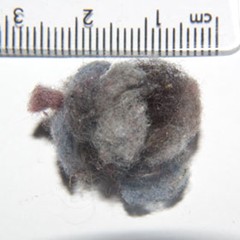
The hypothesis presented herein says that abdominal hair is mainly responsible for the accumulation of navel lint, which, therefore, this is a typically male phenomenon. The abdominal hair collects fibers from cotton shirts and directs them into the navel where they are compacted to a felt-like matter. The most abundant individual mass of a piece of lint was found to be between 1.20 and 1.29mg (n=503). However, due to several much larger pieces, the average mass was 1.82mg in this three year study. When the abdominal hair is shaved, no more lint is collected. Old T-shirts or dress shirts produce less navel fuzz than brand new T-shirts. Using elemental analysis, it could be shown that cotton lint contains a certain amount of foreign material, supposedly cutaneous scales, fat or proteins. Incidentally, lint might thus fulfill a cleaning function for the navel.

An essential navel fluff blog here. And Graham Barker’s legendary collection never ceases to amaze and delight.

Share

→ 3 CommentsTags:·

From the Heyday of Amp

April 21st, 2009


Microkhan’s under super-intense pressure to crank on the screenplay this afternoon, so I’m jetting a bit early today. See y’all in the a.m.—or, if the blogging pull is just too much, later tonight after Microkhan Jr.’s been deposited into Slumberland.

In the meantime, enjoy the vintage Ken Ishii video above, a staple of MTV’s late, great Amp—not to mention America’s ever-so-brief love affair with Japanese techno. Those were the days…

Share

Comments Off on From the Heyday of AmpTags:····

The Somalia of 1855

April 21st, 2009

A dispatch (PDF) from the pirate-filled waters off Canton (present-day Guangzhou). The parallels to modern accounts from Somalia are pretty eerie, especially when you consider that China was undergoing its own brand of internal turmoil during this period:

The pirates, who have always been very numerous and very formidable in these waters, have lately increased to an alarming extent. No sufficient punishment has been inflicted on them, and they have grown audacious beyond measure. They muster by thousands and sometimes go in fleets of sixty and seventy junks. Scarcely any merchantman entering here are safe from assault, and the people of Hong Kong are even apprehensive of an attack on the town.

Read the whole thing. Matters get quite hairy toward the end, when the Porpoise starts flinging 32-pounds cannonballs at the pirates.

Share

Comments Off on The Somalia of 1855Tags:···

The Madden Killer That Wasn’t

April 21st, 2009

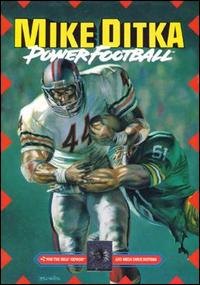
mikeditkapowerfootballMicrokhan is one of the few (American) football fans who doesn’t lament the retirement of longtime TV announcer John Madden. For far too long, the noted fried-food enthusiast has filled airtime with nothing but head-thunkingly obvious comments. His typical pre-kickoff riff over the last decade has gone something like this: “To win, I think they’re gonna have to score some points. But they’re also gonna have to play well on defense.” Thanks, Scoop.

Madden’s departure does, however, revive memories of a bygone era in sports-themed video games, back when the Sega Genesis ruled the roost. It may seem hard to believe now, but Electronic Arts’ Madden NFL franchise was never pre-ordained to become a $2.4 billion behemoth. Back in 1990, more than a little smart money was on Chicago Bears coach Mike Ditka and Mike Ditka Power Football. Oh, what could have been, had Accolade Inc. been able to arrange a licensing deal with the NFL. But for reasons lost to history, Power Football’s publisher screwed the pooch in that regard, and players such as poor Microkhan were forced to control generically named blips.

Worse still, the franchise launched just as Ditka was on the downswing. He was fired a year after the game’s release, and never quite recovered his Super Bowl Shuffle rep. Nor did the Power Football franchise, the vanishing of which cleared the way for the precipitous rise of Madden NFL.

Lesson learned: Never peg your gaming franchise to a specific competitor, since they’re bound to fail sooner or later. That, in a nutshell, is Buster Douglas’s legacy to us.

Share

Comments Off on The Madden Killer That Wasn’tTags:······

Black Death Rethink

April 21st, 2009

blackdeathHave plague-infected rats (as well as their attendant fleas) gotten a bad rap in the history books? A pair of Georgia-based geographers think so. Their rather unconventional theory is that an unknown viral condition, rather than bubonic plauge, was responsible for Europe’s Black Death:

“The Black Death went so fast, but we knew bubonic plague in India in 1903 moved slowly, even with modern transportation,” said Welford, a native of Suffolk, England, where the epidemic hit especially hard.

“(Black Death) was whipping across Europe in two, two-and-a-half years.”

Black Death also peaked in the summer, while bubonic plague, which is carried by rat fleas, peaks in the winter as people congregate inside. How come there are no accounts of rats dying en masse as you’d expect with the bubonic plague? And why, the two wanted to know, did some areas of Europe avoid the disease altogether?

So why did bubonic plague get the blame? The geographers say it all started with the infamous 1894 plague outbreak in Hong Kong, when scientists first discovered the bacteria that causes the disease. Leaps of logic were then supposedly made, based on Medieval accounts of lumpy boils that covered victims.

Though the new hypotheses is certainly appreciated, Microkhan remains (to be charitable) highly skeptical that run-of-the-mill vermin deserves to be let off the hook. But maybe that’s just because we have a tortured history with Rattus norvegicus.

Share

→ 3 CommentsTags:····

Truly Lilliputian Jockeys

April 20th, 2009

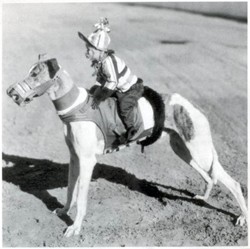
monkeyongreyhound1To paraphrase a great eight-fingered, three-haired philosopher, there are few things in life that can’t be improved by the addition of a monkey. Such is the case with greyhound racing, an on-the-ropes pastime that briefly experimented with monkey jockeys during the Depression. According to a recent Australian reminiscence, things went awry due to the pint-sized simians’ competitive nature:

Alas, monkey racing was a short-lived phenomenon in Sydney, shut down for the pocket jockey’s own protection. So keen were they to claim a winning purse of peanuts, the monkeys began to gravely injure each other in the quest for victory.

More photos here and here. Some race fans have proposed reviving the monkey jockeys as a way to stimulate interest in the fading greyhound industry. If that actually came to pass, the Humane Society would likely be none too amused.

(Via Ell, one of Microkhan’s beloved readers Down Under.)

Share

→ 7 CommentsTags:·····

The Bootlegger in Your Mouth

April 20th, 2009

Over the weekend, Microkhan had the enormous pleasure of re-watching Werner Herzog’s Fitzcarraldo, about a daft German’s attempt to build an opera house in early 20th-century Iquitos. Without giving too much away, the quest brings him in contact with an Amazonian tribe that prepares chicha the old-fashioned way: By balling up the maize in their mouths, and letting their saliva do the fermenting.

Upon seeing this scene, Microkhan wondered how such a thing could be possible. Fortunately, the good folks over at the Journal of Dental Research have the knowledge. Suffice to say that you can ferment pretty much anything with spit, from chocolate cookies to bananas. Sounds yucky, perhaps, but if given a choice between saliva-fermented Saltines or Budweiser Chelada, we’d definitely opt for the former.

Share

→ 3 CommentsTags:·····

The “Threat” of Broader Faces

April 20th, 2009

dillinghamreport
A century ago, the Dillingham Commission was charged with investigating the societal impact of immigration, particularly from Eastern and Southern Europe. The Congressional panel duly churned out a 41-volume report that, for all its regal language and intricate graphs, contains some of the vilest pseudoscientific drivel ever committed to print. Of particular interest to Microkhan is Volume 38, a 580-page behemoth entitled Changes in Bodily Form of Descendants of Immigrants. The report’s author, the well-known anthropologist Franz Boas, argues that certain European races possess unusually broad faces and short heads, which were then thought to be indicators of low intelligence and criminal tendencies. But Boas assures us that, after a generation or two in America, these races can become more, uh, “normal”:

The head form may conveniently be expressed by a number indicating the transversal diameter (or width of the head) in per cents of the diameter measured from forehead to the back of the head (or the length of the head). When the head is elongated (that is, narrow when seen from the front, and long when seen in profile), this number will be low; when it is rounded (that is, wide when seen from the front, and short when seen in profile), this number will be high. The width of the head expressed in percents of the length of teh head is about 78 per cent among Sicilians born in Sicily and about 83 per cent among Hebrews born in eastern Europe. Among Scilians born in America this number rises to more than 80 per cent, while among east European Hebrew born in America it sinks to 81 per cent.

This fact is one of the most suggestive discovered in the investigation, because is shows that not even those characteristics of a race which have proved to the be the most permanent in their old home remain the same under the new surroundings; and we are copelled to conclude that when these features of the body change, the whole bodily and mental make-up of the immigrants may change.

This drivel would be much more entertaining if it hadn’t had such serious policy consequences, including the eventual prohibition of all Asian immigration to the U.S.

When Microkhan comes across pseudoscientific relics of this nature, one question pops to mind: A hundred years hence, which of today’s most cherished scientific “facts” will be regarded as laughably backwards and misguided?

Share

→ 4 CommentsTags:···

Free Roxana

April 18th, 2009

Free Roxana.

Share

Comments Off on Free RoxanaTags:·

Ninjas and Coincidence

April 17th, 2009


One of the things I’ve learned while writing the Now the Hell Will Start screenplay is that it’s tough to make coincidences believable. They’re often necessary for the plot to move forward, alas, so you have to finesse them. You certainly don’t want audience members turning to each other to say, “Um, that wouldn’t happen in a million years.”

For this week’s Bad Movie Friday, I’d like to highlight a flick where the screenwriters definitely didn’t achieve even a scintilla of credibility: American Ninja. Now, I know what you’re thinking—”You’re actually trying to critique the logic in a Michael Dudikoff vehicle?” Okay, I hear ya—no one set out to make this thing into a mid-’80s version of Citizen Kane. But the coincidence at the heart of the movie still rankles, simply because it’s so entirely devoid of thought or care.

In a nutshell, Dudikoff plays a soldier who, as a child, was trained to be a ninja by a kindly old stranger. He is doing menial labor on an Army base when the colonel’s daughter is kidnapped by a gang of ninjas, who work for a local warlord. Complications ensue, but as you might guess, Dudikoff ends up going after the warlord and his ragtag, black-clad mercenaries (who are basically canon fodder, a la Imperial Stormtroopers).

And here’s where the coincidence kicks in: The warlord’s gardener just happens to be…the kindly old stranger who taught Dudikoff his ninja tricks.

This is the sort of smack-your-forehead coincidence that makes frickin’ Crash seem like a paragon of believability. That said, American Ninja could’ve been worse. Steve James turns in a classic sidekick performance, and Judie Aronson is delightfully over-the-top as the spoiled brat in distress. Plus, hey, the title doesn’t lie—no skimping on the ninjas here. If nothing else, it beats Death to Smoochy by a dozen lengths.

Share

→ 8 CommentsTags:······

Second Best by Choice

April 17th, 2009

chiphanauerIn terms of risk-to-reward ratio, there are few sports that can compete with unlimited hydroplaning. While the sport is far less deadly than in bygone days, it’s still not for the faint-of-heart. And unlike such daredevil fare as stock-car racing, there is relatively limited glory to be had (at least outside of the Pacific Northwest). C’mon—how many top unlimited hydroplaners can you name without Googling? Yeah, we thought so.

Well, here are two names to get you started: Bill Muncey and Chip Hanauer, who also happen to be the first inductees into the Unlimited Hydroplane Hall of Champions. That’s Hanauer at the top of this post, celebrating one of his 61 hydroplane triumphs. He could have easily made it 62 or more, but he chose not to:

Bill Muncey is Unlimited Hydroplane Racing’s all-time winningest driver, with 62 victories, 8 Gold Cups and 7 National Championships. Hanuer retired with 61 career wins, rather than eclipse the record of his hero and mentor.

Tough to imagine another athlete pulling up like that, just to honor their idol. But then again, there’s a complicating factor at play here—Muncey perished in a spectacular crash some 28 years ago.

Want to hear more about Hanauer’s generous spirit. He’s available for hire. Or just check out some of his vintage hydroplaning handiwork here.

Share

→ 1 CommentTags:···

Bombs and Otters

April 17th, 2009


There’s such a wealth of fascinating tidbits in this National Nuclear Security Administration archive, it’s hard to know where to begin. Many of the goodies, such as this mind-blowing clip from Operation Castle, will already be familiar to students of atomic-testing history. But others are of a much rarer nature, and some were declassified just last month. The whole catalogue is worth a scan, starting with the two clips from Amchitka, an Aleutian Island where the military conducted three might underground tests between 1965 and 1971.

The clip of the testing itself shows the whole process, from lowering the bombs beneath the ground to the radioactive aftermath. (I wonder what happened to that poor bloke charged with checking out the scene mere moments after the explosion—did that white safety suit really help?) Then there’s this curio, a PR flick about the relocation of Amchitka’s sea otters prior to the second test. I wonder if there’s a similar film that recounts what happened to Amchitka’s human inhabitants, as well as those of surrounding islands.

Much more on Amchitka’s radioactive legacy here. Makes you wonder whether the military was genuinely naive about the long-term impact of underground testing, or just didn’t give a hoot about somewhere so remote.

Share

→ 3 CommentsTags:······

“Four-Toothed Child Was Wild”

April 16th, 2009


I’m off to screenplay for the rest of the afternoon, so I’ll leave y’all with a classic from the Wu-Tang Golden Era. The video is just average shakes up until the part where Ghostface dons the bathrobe. From that point forward, it’s all gravy. (Question: Why are bathrobes generally verboten outside the home? Who will be the fashion icon who liberates us from this tyranny?)

A few years back, I saw Pete Rock do a DJ set during Def Jux‘s CMJ showcase. When he put on this record, the crowd went absolutely nuts. One of my great musical memories of the past decade.

Share

→ 4 CommentsTags:·····

The Decline of Braille

April 16th, 2009

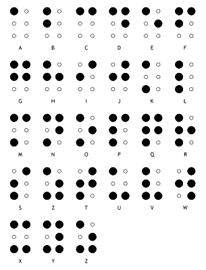
braillealphabetWhenever I’m in an elevator, I take note of whether or not the button numbers are printed in Braille. Not entirely sure why, but I’ve always thought Braille was a brilliant invention—simple, intuitive, and oh-so-useful. And it’s got such a cool backstory, with its roots in 19th-century French spycraft.

But according to a recent report from the National Federation of the Blind, Braille is on its way out:

Fewer than 10 percent of the 1.3 million legally blind Americans read Braille, the system of raised dots that has represented the alphabet to the visually impaired for almost two centuries. Moreover, just 10 percent of visually impaired children are learning the system compared with more than 50 percent during its heyday in the 1950s.

There’s been a lot of handwringing over this decline, with much of the blame ascribed to a lack of trained instructors. But for all of Braille’s brilliance, perhaps its time has simply come. You have to think those million-plus blind Americans aren’t necessarily clamoring for Braille knowledge, but rather just grew up in the age of the audiobook and, perhaps, Dragon Naturally Speaking. The question is, what’s cheaper to produce—an audiobook or a Braille book? I’m guessing the former. And since audiobooks also appeal to the sighted, the choice is a no-brainer for publishers.

For all the good it’s done for millions, perhaps Braille is a technology that’s about to gently fade into that good night. Which leaves Microkhan with a question: Is there an equivalent technology that could someday dinosaur American sign language? Perhaps there’s an iPhone app out there that’s started the process.

Share

→ 11 CommentsTags:···

The Losers Club

April 16th, 2009

clipperslosersThose of you who read Microkhan’s debut post know that management reserves the right to veer away from estoerica on occasion, and delve into topics of a far more personal nature. Well, this is one of those times. Read on if you’d like a brief peek inside Microkhan’s troubled heart; otherwise, fear not, the polymathism will continue shortly.

Last night, Microkhan’s beloved Los Angeles Clippers ended the NBA season in typical fashion—by getting absolutely shellacked. After slogging through yet another sub-20-win season, it’s tough to believe we had such high hopes for this squad last summer. When Baron Davis signed, all seemed promising for a microsecond. But then Elton Brand departed, thanks in large part to coach/GM Mike Dunleavy’s political bungling. It was all downhill from there, save for rookie Eric Gordon’s impressive campaign.

So, as we sift through the wreckage of the umpteenth failed Clippers season, Microkhan must ask the stock annual question: Why do we continue to support such a hopeless, hopeless team? Why must we start each day by scanning the box scores, only to be terribly disappointed three times out of four? Do we really need the aggravation?

You might say that Clippers fans are kindred spirits with supporters of the Chicago Cubs, another franchise known for its futility. But the comparison isn’t quite apt. Cubs fans not only enjoy a sense of community, they enjoy a sense of eternal hope—spurred in large part by the fact that, at least on occasion, expectations have been high. But I rarely come across another Clippers fan here in New York, so there is no community to speak of (save for the virtual one I’ve found at ClipperBlog). And to my knowledge, no one has ever picked the Clippers to achieve anything grander than simply making the playoffs (something they seem to do approximately once a decade).

So for about the 20th year in a row, I’m tempted to trash my Clippers gear and start over with another team. But I know this sensation will pass, and I’ll be right back there with the Worst Franchise in Sports History next year. Maybe that says something rather deep about Microkhan’s personality—that we’re drawn to lost causes and hopeless cases, and find some sort of beauty in the misery. But there’s also a part of the human psyche that retches at the thought of betrayal, however logical that betrayal might be. Yes, the revulsion we feel at becoming fair-weather fans could very well be part of the caveman brain that got our species through Paleolithic. I mean, I’m sure many a fur-clad Homo sapiens was tempted to abandon his clan when food was scarce. But gosh darnnit, what sort of evolutionary strategy is that? And so our forefathers’ anti-betrayal instincts kicked in, and everyone went mammoth hunting.

And so though things look typically grim in Clippersland, Microkhan still looks forward to Opening Day this fall. Yes, there will be wretchedness. But I’ll sleep better knowing that I never abandoned my first love during its eternal night.

And, of course, if by some miracle the Clippers ever do get past the second round of the playoffs, Microkhan is gonna go buckwild in celebration. We’re totally gonna buy and drink this.

Share

→ 6 CommentsTags:···

When It’s Miller Time Around the World

April 16th, 2009

Perhaps the most intriguing part of this chart is realizing that the United States remains a Puritanical outlier. The only other non-Muslim nations that adhere to the 21-across-the-board rule are Fiji, Palau, and Micronesia. Yet if any American politician dare utter a peep about lowering the drinking age, they’re shouted down as if they’d come out in favor kneecapping orphans.

Share

→ 3 CommentsTags:····

Grieving Pachyderms

April 15th, 2009

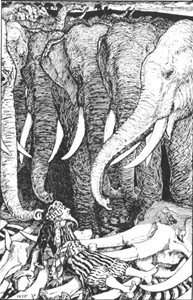
elephantburialHumans and elephants have been intermingling since time immemorial, so it’s a little surprising to discover that we’re still not entirely sure how our pachyderm friends deal with their dead. Oh, we’re pretty sure the mourn, and they appear to cover their pals with leaves and sticks, too. But those elephant burial grounds mentioned in Arabian Nights? Our mammoth mammal friends aren’t quite that picky.
In the course of pursuing our recent Sri Lanka obsession, Microkhan has been reading James Emerson Tennent’s Ceylon, an 1860 account of life on the island nation. There’s an excellent (albeit dated) chapter on Ceylonese elephants, which includes a lengthy digression on burial. To Tennent’s consternation, even the island’s most dedicated naturalists could shed little light on the issue:

A European gentleman, who for thirty-six years without intermission has been living in the jungle, ascending to the summit of mountains in the prosecution of the trigonometrical survey, and penetrating valley in tracing roads and opening means of communication—one, too, who has made the habits of the wild elephant a subject of constant observation and study—has often expressed to me his astonishment that after seeing many thousands of living elephants in all possible situations, he had never yet found a single skeleton of a dead one, except of those which had fallen by the rifle.

It has been suggested that the bones of the elephant may be so porous and spongy as to disappear in consequence of early decomposition; but this remark would not apply to the grinders or to the tusks; besides which, the inference is at variance with the fact, that not only the horns and teeth, but entire skeletons of deer, are frequently found in the districts inhabited by the elephant.

The natives, to account for this popular belief, declare that the herd bury those of their companions who happen to perish. It is curious that this belief was current also among the Greeks of the Lower Empire; and PHILE, who wrote at Constantinople early in the fourteenth century, not only describes the younger elephants as tending to the wounded, but as burying their dead.

Alas, Manuel Philes’s De elephante does not appear to ever have been translated from the Greek. We’ll assign that task to Microkhan Jr., though perhaps not until he’s mastered at least a few words in English.

Share

→ 1 CommentTags:···

Lehman and Yellowcake

April 15th, 2009

An epic-fail investment bank owns the rights to “enough uranium cake to make a nuclear bomb.”. Should you be worried? Microkhan breaks down the yellowcake game here. Interesting to note that raw uranium prices have nearly quadrupled over the past six years. We really should read this to find out why. It’s going on the to-check-out list, right behind In the Forbidden Land.

Share

→ 1 CommentTags:··

Bare-Knuckle Politics in Terre Haute

April 15th, 2009

The whole senatorial brouhaha in Minnesota has nothing on the ongoing mayoral battle in Terre Haute, Indiana. The loser in the city’s 2007 election is still contesting his defeat, on some seriously esoteric grounds:

Burke v. Bennett pits former Mayor Kevin Burke against current Mayor Duke Bennett, who won the 2007 election by 110 votes out of about 12,000 cast. However, Burke argued — after the election — that Bennett had been ineligible to run due to the Hatch Act, a law that limits the political activity of people paid with federal funds, including employees of some not-for-profit agencies that receive federal money.

Before being elected, Bennett was director of operations at the Hamilton Center, a not-for-profit mental health organization that includes a federally funded Head Start program.

Microkhan now understands how such madness might inspire the city’s garage bands to great feats of musical creativity.

Share

Comments Off on Bare-Knuckle Politics in Terre HauteTags:···

The Mutineers’ Revenge

April 15th, 2009

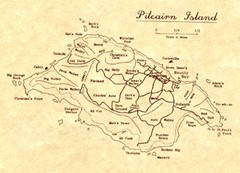
pitcairnislandYesterday’s post about Political Power Units (PPUs) and the Polynesian island of Niue attracted a few dissenting e-mails. These correspondents argued that Microkhan got it wrong by a country mile, and that Niueans are political weaklings when compared to their South Pacific neighbors:

Niue, powerful? Don’t make me laugh, O Mighty Microkhan. By contrast, I give you Pitcairn Island: 48 descendants of the HMS Bounty‘s beleaguered Captain Fletcher Christian. 10 of them serve on the Island Council; 5 of these are elected by popular vote.[See the CIA Factbook for more info—ed.]

Which gives Pitcairn’s impossibly inbred and isolated citizens an enviable PPU of 0.104 apiece.

Not bad, Pitcairn mutineers. Not bad at all.

There’s a potential technical issue here, in that Pitcairn is pretty clearly a British territory; Niue, by contrast, enjoys a so-called “free association” with New Zealand. But Microkhan will let that slide, on the grounds that Pitcairn does have a written constitution, which dates back to 1838.

Plenty more about Pitcairn’s political history can be gleaned from the Pitcairn Islands Study Center at Pacific Union College. And tonight, be sure to down a shot of Crown Royal in honor of Pitcairn’s recent decision to lift its 200-year-old ban on the consumption of alcohol.

Share

→ 3 CommentsTags:···

What a Shame

April 14th, 2009


The Jones Girls were by no means a great group. They too often veered into easy-listening terrain, and committed a cardinal music-biz sin by partnering with Lou Rawls (so famously slammed by The Pharcyde many moons ago). But the Girls also produced a song responsible for one of the greatest hip-hop samples of all time: “When I’m Gone” (via YouTube above) was copped by Royal Flush, who made it the backbone of his classic “What a Shame”. And so the lite-soul pride of Detroit earns its place in music history.

Now if I could just figure out the sample used at the end of Smif-n-Wessun’s “We Came Up (Crystal Stair)”. That one’s been hooked into my brain for ages.

Share

→ 3 CommentsTags:·····

Lion Meat Prices

April 14th, 2009

The latest furor over sales of lion meat spurred Microkhan to look up the delicacy’s pricing history. According to this 2003 article, a pound of lion meat then went for roughly $35, or $2.19 per ounce. Five years later, a reporter for the St. Petersburg Times had a 14-ounce lion chop at a steakhouse, a feast which cost her $48 ($3.43).

It’s a bit unclear what’s happened since, but the latest lion-meat vendor to hit The Tubes is selling the stuff for a fortune: $199.99 per pound, or $12.50 per ounce.

Microkhan can only guess at why prices have soared. Perhaps vendors have added an “outrage premium,” seeing as how the lion-meat trade has stirred up passions among animal-rights activists. Or maybe, as some exotic-game gourmands have long suspected, cheaper lion isn’t really lion at all, but rather liger, cougar, or another big cat. Even a discerning palate would be hard-pressed to tell the difference, or so we guess.

For the record, Microkhan (a dedicated omnivore) is pretty skeeved out by the notion of lion meat. It’s perfectly legal in this country, assuming the cats weren’t housed on a rescue preserve. (A Missouri ranch once got in serious hot water for flouting that rule.) But I dunno—there’s something rather unsporting and sad about turning Aslan into dinner. We’ll stick with squab, thank you very much.

Share

→ 2 CommentsTags:··

The World’s Most Powerful Citizens

April 14th, 2009

niueMicrokhan’s been reading everything under the Sun regarding the forthcoming Indian election, a true marvel of democracy. Yesterday’s fodder was this New York Times bit on the growing political enthusiasm of India’s urban elite. Buried amidst the reporting was a rather gobsmacking fact: only 543 members of the nation’s parliament are directly elected by the people. (This presumably refers solely to the Lok Sabha, or lower house of parliament; the upper house is indirectly elected, a bit like the United States Senate before the 17th Amendment.)
Given India’s ginormous population, that seems like a pretty miniscule number of political reps. In fact, a quick back-of-the-envelope calculation reveals that each Indian enjoys a Political Power Unit (PPU) of just 0.000000473. (A PPU, which Microkhan just made up over coffee, is number of elected representatives divided by total population.) An American, by contrast, is blessed with a PPU of 0.00000176. Joe Q. Swede? That tall, blond lucky ducky gets a PPU of 0.000386.

But no political entity on Earth can compare with Niue. Though the island nation isn’t entirely independent—New Zealand handles its foreign affairs and defense—Niue is essentially autonomous, with its own constitution and parliament. That legislative body consists of 20 people—small by most standards, but mighty large considering that Niue’s population is under 1,400. That means a Niuean enjoys a PPU of 0.0143—by far the biggest on the planet, at least according to Microkhan’s relatively cursory research.

If anyone can think of another nation that can beat Niue in terms of PPUs, please advise. Don’t even bother suggesting Andorra—Microkhan ran the numbers, and it’s way behind Niue.

(Image from Going Postal T-Shirts)

Share

→ 3 CommentsTags:····

Ride the Sheep

April 13th, 2009


Ladies and gentleman, please meet the second-best female mutton buster in all of Montgomery County, Texas. Don’t let the pink helmet fool you—young KaLee is as tough as they come. If that clown hadn’t snatched her away at the end, I reckon she’d still be riding.

A much less successful ride from the San Antonio rodeo is here. And because Microkhan is all about presenting both sides of the story, the case against this pee-wee rodeo event can be gleaned here.

Microkhan Jr. likely won’t participate. His sport’s gonna be modern pentathlon.

Share

→ 2 CommentsTags:····

The Enigma of Kagnew

April 13th, 2009

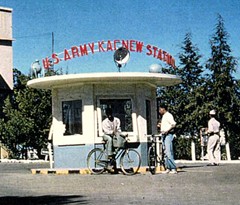
kagnewstationNow a somewhat secretive Eritrean military base, Kagnew Station was one of America’s key listening posts for much of the Cold War. Radios located here are able to pick up clear signals from thousands of miles away; local AM stations in Asmara have reported hearing Finnish broadcasters on occasion.
Altitude plays a big role in Kagnew’s magic, as does the relative quiet of the plains below. But those factors alone can’t quite explain why a short-wave radio at Kagnew can pick up Bulgarian chatter with little difficulty. In I Didn’t Do It For You, a history of modern Eritrea, Michaela Wrong offers a scientific guess:

Some experts have speculated that Asmara benefits from another intriguing natural phenomenon—”ducting”—in which radio signals rise through the earth’s atmosphere, bounce horizontally along under the troposphere and return to earth via “ducts” thousands of miles away from their original source.

Oodles more on Kagnew here, a site maintained by American veterans from the listening-post days. The user-submitted photos are excellent time wasters.

Share

→ 6 CommentsTags:···

The Kentucky Vendetta?

April 13th, 2009

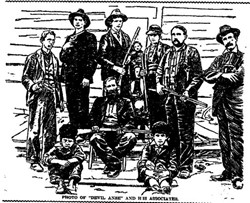
appalachianfeudsThe nation-at-large first awoke to the notion of Appalachian feuding thanks to this 1885 New York Times article (PDF). Entitled “The Kentucky Vendetta,” the piece recounted a Rowan County spat that arose over a charge of horse thievery. The writer contended that when the courts were unable to provide appropriate redress, the Underwood and Holbrook families picked up their rifles and pitchforks:
I believe some 30 were “picked off” in the Underwood-Holbrook feud. It lasted over two years, and culminated in the most inhuman and treacherous affair of all. “Old Underwood’s gang” had lived in a log house “fort like” for two years in a state of siege almost constantly. Now an “outsider” would be picked of, and then an insider would bite the dust. I mean by insider an Underwood, and by outsider a Holbrook. One night a shot or two hit Jesse Underwood. He died. Thus was the father childless; all the boys were gone. He sat alone with a grandchild and his old wife, the dead body of his pet boy lying at their feet.

Such tales would become a staple of the Times over the ensuing decade, as the urban middle-class developed a curious fascination with Appalachia’s ostensible culture of honor and violence.

But was it all a malicious distortion? Several recent scholars of 19th-century Appalachia claim that the feuds existed only in East Coast imaginations, and that the region’s violence amounted to little more than drunken young men foolishly trying to establish their bona fides. Check out Altina L. Waller’s “Feuding in Appalachia” for a contrarian take; the UConn professor says that economic hardship, rather than genuine familial hatred, was at the root of these supposed blood feuds. Her paper also includes a highly entertaining list of feuds reported in both the Times and the Louisville Courier-Journal. Bet that Sizemore-Garrison feud in Clay County was all sorts of crazy.

The Hatfields and McCoys, by the way, now settle their differences on the softball field.

(h/t Libby’s Genealogy)

Share

Comments Off on The Kentucky Vendetta?Tags:···

“…And a Very Fast Ostrich”

April 10th, 2009


In celebration of the forthcoming Easter holiday, Microkhan would like to offer a very special dud for Bad Movie Friday: the infamous Leonard Part 6. The Bill Cosby spy spoof is allegedly a comedy, but is known to evoke fewer laughs than the typical root canal. As the Washington Post‘s Rita Kempley so succintly put it in her pan:

Not only is this movie subliterate, it’s sub-Smurf.

Also, check out Siskel & Ebert’s take here. Ebert really doesn’t seem too psyched about the intersection of, uh, “art” and commerce in this flick.

Hollywood was slow to forgive Cosby for this one, despite the fact that he was then starring in one of the biggest TV hits of all time. It took three years before Cosby was given another silver-screen vehicle: Ghost Dad. And we all know how that turned out.

Oh, you don’t? Count yourself lucky, dear reader. Count yourself lucky.

Share

→ 3 CommentsTags:····