Microkhan by Brendan I. Koerner

Microkhan by Brendan I. Koerner header image 1

The Ghost Fleet

April 10th, 2009

ghostfleetThe ultimate fate of the National Defense Reserve Fleet has become a hotly contested matter in recent years, as environmentalists claim the aged ships are leaking nasty toxins into California’s Suisun Bay. That certainly seems logical, since these rusting hulks were built in the age of asbestos, lead paint, and other environmental bogeymen. But a recent report (PDF) from the National Oceanic and Atmospheric Administration claims otherwise:

Sediments from the SBRF study area and the rest of Suisun Bay have a low to moderately low potential for toxicity to benthic invertebrates. The contaminant concentrations observed are largely comparable to values for the same metals and organics measured in other regions of the greater San Francisco Bay. Following this analysis, NOAA does not recommend specific sediment remedial actions in the vicinity of the SBRF at this time.

This report may clear the way for several of the fleet’s minor ships to be scrapped in situ. So before they disappear, pay a virtual visit to the NDRF by using this awesome Google Map, created by the good folks at KQED. Pick your favorite mothballed ship of yore; Microkhan has always been particularly partial to the USS Thomaston.

Share

Comments Off on The Ghost FleetTags:···

Wonderful Chaos

April 10th, 2009

indiaelectionsymbolIn terms of sheer magnitude and complexity, nothing on Earth can beat India’s electoral system. Indian election officials must ensure fair play in a nation of 1.15 billion souls, where a multitude of languages are spoken and infrastructure can be less-than-ideal. On top of that, India’s sheer passion for electoral politics means that minor parties number in the hundreds. In fact, according to the Electoral Commission of India, there are currently a shade over 1,000 political parties in the country, though the vast majority fall into the limbo-like category of “registered but unrecognized.” This means a party has but a bare handful of members, and thus doesn’t qualify for that most important of political privileges: an election symbol.

Given that India’s literacy rate is still just 61 percent, symbols mean so much to the electoral process. The Electoral Commission is tasked with assigning symbols to each party. For mainstays such as Congress and the BJP (whose lotus is depicted above), these symbols have been set in stone for years. But for upstarts and state-based parties, a lot rides on how cool a symbol they can wrangle.

And wrangle they must, since there is a concrete list of pre-approved symbols from which the parties must choose. Table IV of this document (PDF) runs them all down. And what a random lot they are—I shudder to think what minor party will someday count itself fortunate to campaign under the sign of the ice-cream cone, the battery torch, or the harmonium. Then again, if you’re the head of the Bharat Pensioner’s Front (unrecognized party number 145) or the Life Peaceful Party (#518), you’re probably happy to take what you can get.

Share

→ 5 CommentsTags:·

Chechnya and the Zikr

April 9th, 2009


With Chechnya back atop the news, Microkhan wanted to take a moment to delve into the country’s rich-yet-brutal history. Much of what we know comes from the excellent 1998 book Chechnya: Calamity in the Caucasus. It’s dated, of course, since it stops well short of Russia’s comeback and the installation of a murderous, Kremlin-friendly regime. But it provides historical context for the conflict, and does a fine job of illustrating why so many Chechens resist any sort of Russian national identity.

One of the book’s key points is that the uniqueness of Chechen religious practices makes the society incompatible with Russia. The Chechens follow a brand of Sufi Islam that focuses on an ecstatic sort of worship—the circular zikr, depicted above. As the authors explain:

The Qadiriya originated in Baghdad in the twelfth century and was brought to Chechnya by the Dagestani sherpherd Kunta Haji. Qadiri worship is more dramatic; its adepts perform in the loud zikr in which they rush round in a circle, shouting holy prayers even louder and louder in an ecstasy of clapping and stamping. When Jokhar Dudayev seized power in 1991, the zikr became a political spectacle, and dozens of dancers gathered in the central square in Grozny and danced more and more furiously. When the Russians were poised to invade, it became an independence dance as one desperate dancer rand around the circle brandishing a Chechen flag, pressed in by a crowd of rhythmically clapping people.

Microkhan will follow soon with more Chechnya posts. It’s been a longtime subject of fascination ’round these parts.

Share

→ 3 CommentsTags:·

Doctor Bigtime

April 9th, 2009

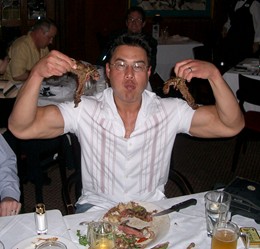
doctorbigtimeJuris Shibayama is a modern-day Renaissance man, whose talents range from orthopaedic surgery to bodybuilding to the inhalation of hamburgers. The last of these skills has earned him rising-star status on the competitive eating circuit, where he’s currently ranked twelfth in the world (just below the great Patrick “Bib Sheet” Vandam).

Shibayama, who immodestly (yet accurately) calls himself “Doctor Bigtime,” recounts the feat that made him first realize he could someday rule the world of professional eating:

At Don Shula’s steakhouse in 2005, I ate two 48-oz porterhouse steaks, along with appetizers, caesar salad, bread, beverages, and two desserts.

Impressive. But does he have what it takes to break Microkhan’s favorite eating record? That would be the one held by Oleg Zhornitskiy, in the mayonnaise category: 128 ounces in 8 minutes. Please don’t try that at home, dear readers.

Share

→ 2 CommentsTags:··

Suicide in the Treasure State

April 9th, 2009

montanasealLongtime readers know that Microkhan has a curious obsession with suicide. (We blame Ozzy Osbourne and Randy Rhoads.) So we couldn’t help but notice the fact that Montana has by far the highest suicide rate in the U.S., at 22 cases per 100,000 residents. That leaves even Nevada and its legions of busted, coked-out gamblers in the dust.

Yet here’s the rub: While Montanans appear to be killing themselves at an alarming rate, they’re quite reluctant to turn their pain or fury outward. The state has the nation’s second lowest homicide rate, behind only New Hampshire. What gives?

The standard explanation is that residents of Montana’s rural areas are ashamed of depression, and so don’t seek treatment until it’s too late. On top of that, rural dwellers are often more prone to suicide than their urban counterparts, though the reasons for this are not entirely clear. (Poverty is often said to play a role, but that’s probably less of an issue in Montana than in the hinterlands of, say, China or Bangladesh.)

Gun ownership has to be a factor, since it’s far easier to kill one’s self with a firearm rather than pills, carbon monoxide, or the noose. Montana has the third highest rate of gun ownership in the U.S., behind only Wyoming and Alaska (two other states with disturbingly high rates of suicide).

But Microkhan thinks the overlooked factor here is proximity to emergency medical care. Keep in mind that for every suicide in the U.S., there are nearly 19 unsuccessful attempts. What keeps the failure rate so high—and has slowly decreased the American suicide rate over the past 60 years—is more effective ER treatment. But that requires getting to the hospital quickly, and that’s just not possible in more rural areas.

Unfortunately, there’s doesn’t seem to be a quick fix to this problem, seeing as how there probably isn’t much cash available to build new ERs around Wolf Point. Perhaps the state government should just distribute Mormon literature and Prozac.

Share

→ 9 CommentsTags:···

Is It Real, or Is It Moissanite?

April 9th, 2009

diamondtesterEven expert jewelers can mistake a well-crafted slab of paste for the genuine article. Or at least that’s the theory behind DiamondNite, a hand-held gadget that beeps when it’s placed against a diamond, yet remains silent when brought in contact with cubic zirconia or moissanite. DiamondNite’s manufacturer won’t reveal how the device works, but Microkhan suspects it’s just a very basic (and slightly overpriced) breed of spectrometer.

Microkhan also highly doubts that the DiamondNite can catch truly well-done ersatz gems, especially in this day and age of the synthetic diamond. If DeBeers and its zillions of high-tech gadgets can’t tell the difference, neither can the $199 DiamondNite.

Share

→ 10 CommentsTags:····

“It’s Time”

April 8th, 2009


Microkhan is off to the Elm City today, so this’ll be the last post for the next, oh, 19 hours or so. Thought I’d keep on this week’s Soviet-invasion theme, by offering up the climactic scene to Chuck Norris’s Invasion USA. I don’t think a spoiler warning is necessary, since no moviegoer with a half a brain would actually expect the Soviets to beat Norris on his own turf.

The Leninist baddie who gets his comeuppance here, in the most over-the-top fashion imaginable, is B-movie legend Richard Lynch. He plays a Soviet officer who leads a ragtag band of Latin American guerrillas up the Florida peninsula, until they meet their mulleted executioner in Atlanta. Yes, really, that’s the plot—approximately 300 foreign soldiers march from Miami to northern Georgia, causing unspeakable havoc en route. Were this to happen in real life, of course, I doubt they’d make it much past Pembroke Pines, seeing as how nearly a quarter of Floridians own guns. (Though far fewer, I’m willing to bet, own rocket launchers.)

Catch you tomorrow. Or, if you are a Yale student, perhaps I can catch you today: I’m doing a Master’s Tea at Stiles at 4 p.m. Please swing by if the spirit moves you.

Share

→ 2 CommentsTags:···

Biocontrolling Fire Ants

April 8th, 2009

phoridflyMicrokhan’s Sun Belt readers are likely all-too-familiar with the ravages of imported fire ants—especially if they’re in the business of providing us carnivorous Americans with our delicious, delicious burgers and tripe. Imported fire ants enjoy few victuals more than the flesh of a baby calf. As a result, the critters cost ranchers zillions every years.

The ants are thus a hot topic at this week’s TSCRA Convention, an annual pow-wow of Texan cattlemen. Those ranchers are being told that the solution is not more and better pesticides, but rather the humble phorid fly (pictured at right)—or, more precisely, a carefully bred species of phorid fly that will eat imported fire ants, and absolutely nothing else.

Here’s all you need to know about fire ants, phorid flies, and even armadillos, courtesty of the Brackenridge Field Laboratory. And while we’re on the topic of ants, you should spare a few moments for Carl Stephenson’s classic short story Leiningen versus the Ants. It’s the tale that made Microkhan want to become a writer in the first place.

Share

→ 3 CommentsTags:····

“I Am the Hunter”

April 7th, 2009


Following on yesterday’s mention of the brief heyday of Soviets-invade-the-Heartland films, Microkhan feels morally obligated to post the above Red Dawn clip. In the interests of novelty, we’ve steered clear of the obvious—no “Wolverines!”, no “Avenge me!” Today’s pick is the more obscure, but equally delicious scene in which the evil Soviet commander demonstrates the power of a well-crafted metaphor—as well as his commendable knowledge of Gulo gulo behavior.

Note the overly sunglassed Cuban commando at the end of the clip. Drastically receding hairline be damned, that guy means business.

Update: An eagle-eyed reader informs us: “That’s no mere ‘overly sunglassed Cuban commando’ in Red Dawn. That’s Ron O’Neal, aka Superfly.”

Share

→ 2 CommentsTags:··

Draft as Drain

April 7th, 2009

Upon learning that Poland is set to end military conscription starting early next year, Microkhan got to wondering about the economic effects of nixing the draft. Is it a net good to have thousands of 18-to-21-year-olds pounding the pavement in search of jobs or educations, as opposed to learning how to march and fire weapons?

This study, which focused on the financial fates of thousands of British men, pretty clearly comes down on the side of ending conscription:

Our results suggest that the effect of military conscription on subsequent earnings is significant and long-lasting. Males who served for two years in the National Service earn on average between 4 and 6 percentage points less than the immediately subsequent cohort exempt from compulsory military service. We find very little evidence that the effect of military service on subsequent earnings is through education. In fact, our estimates show that exempt cohorts accumulate on average only a quarter of a year of additional education.

Granted, however, there is a chicken-or-egg issue here. Nations typically end conscription only after they’ve attained a sufficient amount of both external and internal security, which means the next generation’s prospects are already looking pretty bright.

Then there are random holdouts like Switzerland and Sweden, which keep on drafting despite their prosperity. Although even the Swedes are starting to buckle.

Share

Comments Off on Draft as DrainTags:···

A Banker Who Spent Wisely

April 7th, 2009

aztecmushroomgodIn sorting through the detritus of Depression v2.0, it’s gobsmacking to realize how much money the financial Masters of the Universe wasted on baubles and trifles. As this recent New York confession makes clear, bankers earning millions were stunningly unimaginative when it came to disposing of their lucre. Cars! Single malts! Vacation homes! Yawn…

When the going was good, these bankers should’ve taken a cue from a creative, courageous predecessor: R. Gordon Wasson, a J.P. Morgan bigwig who used his zillions to pursue his love of ethnobotanical research. Whenever he could grab a few spare weeks, Wasson didn’t jet to the Hamptons to drink margaritas and play croquet. Instead, he and the missus would jaunt down to southern Mexico, where they’d sample a wide panoply of psychoactive mushrooms—solely in the name of research, of course.

Wasson’s travels led him to publish this landmark Life magazine story in 1957. A small sample from his first-hand account:

The visions came whether our eyes were opened or closed. They emerged from the center of the field of vision, opening up as they came, now rushing, now slowly, at the pace that our will chose. They were in vivid color, always harmonious. They began with art motifs, angular such as might decorate carpets or textiles or wallpaper or the drawing board of an architect. Then they evolved into palaces with courts, arcades, gardens–resplendent palaces all laid over with semiprecious stones. Then I saw a mythological beast drawing a regal chariot. Later it was though the walls of our house had dissolved, and my spirit had flown forth, and I was suspended in mid-air viewing landscapes of mountains, with camel caravans advancing slowly across the slopes, the mountains rising tier above tier to the very heavens.

Microkhan firmly believes that the accumulation of copious Prada bags and fine Burgundies is relatively weak tea by comparison.

Much more on Wasson’s curious career is available through his archives at Harvard. And his fascinating Persephone’s Quest, a treatise on the connection between ethnogens and religious development, is now available for free via Google.

Share

→ 4 CommentsTags:·····

CSWs and PCR

April 7th, 2009

As a proud realist, I’m typically sympathetic to commercial sex worker (CSW) campaigns that seek legitimacy for their members’ chosen trade. That doesn’t mean I lack all squeamishness about the cash-for-flesh exchange, but I acknowledge that it’s called “the world’s oldest profession” for a reason. The transparency that is supposed to accompany legitimacy strikes me as something rather desirable, since abuses flourish more in the dark than in the light.

So Microkhan was struck by the latest news out of Kolkata, where the city’s CSWs are trying—for the umpteenth time—to flex a little political muscle:

The group that call themselves ‘Urbar Mahila Samanya Committee’ is an initiative of the sex workers of the red light area of Sonagachi, and their demand looks nothing new: application of the labor rights for their profession, which has been a ongoing discussion in India for a long time.

The demands, which have been placed in front of each of the political parties also includes: acceptance of their profession by the society, government affiliation of sex workers, non discrimination of their children or family members and freedom from police oppression. “In West Bengal, there are 70,000 sex workers. After including their family members, the total population of the voters would be 2, 80,000. So with such a huge vote bank, we should get equal rights like people from other sections of the society,” said Bharati Dey, sex worker and Project Director of Durbar Mahila Samanya Samiti, Sonagachi.

But if effective CSW regulatory regimes are to be designed, a couple of huge questions remain. And chief among them is how to ensure that CSWs adhere to public-health regulations. In West Bengal, for example, would the government-run clinics really have the means to test 70,000 individuals each month? And would those individuals really want to spend 1/30th of their month waiting in long queues for the privilege?

One possible solution, however, was recently proposed by Patrick Kimmitt of the University of Westminster. His study attested to the potential efficacy of remote testing, using swabbed bits of DNA. Imagine this: a CSW mails in her DNA every month, and regulators mail her back a one-month renewal on her license to practice. No clinic queues, and no need for phlebotomists. Best of all? Polymerase chain reaction (PCR) of DNA is a much more reliable way of testing for STDs than traditional methods.

Yeah, sci-pol wonkery isn’t too erotic. But neither is the clap.

Share

Comments Off on CSWs and PCRTags:····

“Where Was All That Patriotism When It Counted?”

April 6th, 2009


Even in their wildest schemes, the Soviets likely never contemplated the invasion of America. Okay, maybe they would’ve liked to bite off an Aleutian Island or two. But sweep into the Heartland and bring the word of Lenin at gunpoint? Yuri Andropov wasn’t exactly Genghis Khan, in terms of expansionist vision.

But, oh, how Hollywood wished it were otherwise, at least during the mid-’80s. Red Dawn gets most the nostalgic ink, but there was a cottage industry in “The Russkies are coming!” paranoia during Microkhan’s formative years. And no slab of media made as much of an impression as Amerika, which depicts the United States ten years after a Soviet takeover. The trailer above, which highlights the prominent roles played by Kris Kristofferson and Mariel Hemingway’s eyebrows, is pure comedy gold in retrospect, particularly for the unironic use of the phrase “I don’t even know you any more.”

Then again, is the fact we’re writing these words an indicator that our guard is down? Is Microkhan falling into Putin’s trap? And if the Russians do come, will they really insist on having tinted windows for all their vehicles?

Share

→ 12 CommentsTags:··

Iced Out

April 6th, 2009

Speaking of Frozen Hades as we do in the post below, Microkhan couldn’t help but notice the recent grim news from the planet’s roof. Seems that if things keep going as they are, Santa’s workshop will be bereft of ice before 2040.

When climate-change skeptics hear news of this magnitude, their stock response is to nod southward. What, they say, of the fact that Antarctica seems to be adding ice? Doesn’t that compensate for the losses up top? Last June, Microkhan tried his best to provide an answer here.

Share

→ 1 CommentTags:···

The Overlook Hotel Times Twelve

April 6th, 2009

greenlanddyeOne of my great regrets was not bringing a camera on my 1999 trip to the heart of the Greenland ice sheet. I was there doing a freelance piece on the Air National Guard unit responsible for resupplying polar scientific missions; we spent three days on the ice, learning how to survive in the event of a crash. (Rule Number One: if you see a polar bear, put your head between your knees and kiss your ass goodbye.)

The highlight of the trip was a snowmobile ride out to DYE-2, an abandoned American radar station that scanned the heavens for Soviet ICBMs in the pre-satellite era. The place was hella spooky—like something the Empire would’ve constructed on Hoth after routing those pesky rebels.

Fortunately, more recent visitors have remembered to tote along their PowerShots. Check out this excellent gallery, which includes interior shots; the DYE-2 staffers were in such a rush to get out of Frozen Hades that they left behind everything—including a rather impressive collection of vintage porn.

More on America’s polar radar outfits here. How these mega-isolated skywatchers kept from going crazy is beyond me.

Share

→ 2 CommentsTags:···

The Man Who Heard Voices

April 6th, 2009

Contrary to what Law & Order reruns have taught a generation of armchair lawyers, the so-called insanity plea is the rarest of legal birds. According to one New York study, which looked at a decades’ worth of court data, psychiatric defenses were attempted in roughly 0.16 percent of criminal cases. Yet even when both sides agree that the defendant is mentally ill, pleas akin to “not guily by reason of mental defect” are unsuccessful more often than not. That’s primarily because the American legal system has such an archaic understanding of schizophrenia.

Take the ongoing saga of Ryan Peeler, a Utica, N.Y., man who stabbed his mother to death while in the throes of psychosis:

Peeler believed his mother had taken thousands of tele-connectors from telephone poles and attached them to his spine, which caused Peeler a great deal of pain, Nebush explained. These devices, Peeler thought, would then connect him to other dimensions, from where evil would be siphoned into his mind.

The prosecutor in Peeler’s case freely admits that the defendant suffers from a severe form of schizophrenia. Yet he argues that, in the eyes of the law, Peeler is still culpable because he understood the consequences of his actions. In other words, because Peeler was aware that his mother’s death was permanent, he is as much a murderer as, say, an armed robber who shoots one of his victims.

Microkhan understands why the law needs to err on the side of caution in these cases, since there’s always the threat of malingering. But it also strikes us that the legal system’s understanding of schizophrenia stopped evolving sometime around the Harding administration. Schizophrenics are rarely the raving lunatics of the Victorian imagination, but rather functional people whose worldviews make perfect sense to them, based on their “special” information. Microkhan, for example, has a dear friend who suffer from schizophrenia, yet has occasionally managed to attain fantastic success in the world of business. You’d never know of his troubles until he quietly informs you of the fire engines that follow him, or the fact that he’s recently spent several nights on park benches.

The legal system obviously needs more flexible criteria to determine whether or not schizophrenic defendants are truly, morally responsible for their felonious actions. One good place to start: a rule-of-thumb that determines whether the motive was spurred by delusion, not whether the perpetrator couldn’t comprehend the finality of death. But Microkhan realizes the odds of this happening are slim to none; the desire for vengeance usually trumps the yen to spread rationality, at least when it comes to parricide.


Share

Comments Off on The Man Who Heard VoicesTags:···

“Odd, Inexplicable, and Unpleasant”

April 3rd, 2009


Once again, the joyous end of the work week spurs Microkhan to dredge up a hilariously negative movie review of yore. This week’s slab of celluloidic infamy is Death to Smoochy, perhaps history’s greatest testament to Robin Williams’s talent for irritation. As depicted in the video above, it also features Ed Norton singing an anti-heroin folk song while dressed as a pink rhino. How director Danny DeVito couldn’t see “box-office poison” written all over this project is anyone’s guess.

The movie’s sole redeeming feature? It gave the opportunity for the great Roger Ebert to spit some serious venom. The lead paragraph of his evisceration:

Only enormously talented people could have made Death to Smoochy. Those with lesser gifts would have lacked the nerve to make a film so bad, so miscalculated, so lacking any connection with any possible audience. To make a film this awful, you have to have enormous ambition and confidence, and dream big dreams.

The film’s finale, Ebert also informs us, involves “a lesbian hit-squad leader with a thick Irish brogue.” We’ll take his word on that.

Share

→ 5 CommentsTags:···

Microkhan’s Kind of Research

April 3rd, 2009

The Journal of the American Society of Brewing Chemists rarely fails to be a highly entertaining read, and the latest issue is no exception. Most of the articles are far too technical for the layman to grok; Microkhan’s eyes certainly glaze over at the mere mention of “alpha-acids isomerization yield”. But the issue’s lead piece, by a quintet of Japanese researchers working for both Niigata University and Sapporo Breweries, is nothing short of pure genius.

The researchers set out to measure, with amazing precision, the strength required to swallow various types of beer. Their test subjects were a lucky bunch, assuming they didn’t mind all the electrodes connected to their gullets:

The sensation in the throat while drinking is important for beer. To evaluate this feeling, we developed a noninvasive biometric system for measurement of the swallowing motion while drinking. The system measures movement of the Adam’s apple and provides an electromyogram (EMG) of the throat musculature and swallowing sounds by simultaneously employing pressure sensors, EMG electrodes, and microphones, all mounted on the throat surface. As analytic parameters, we used the period of larynx heave, throat muscular activity, and intervals of swallowing sound.

Their conclusion? Brewers should strive for beers that produce a “short laryngeal movement time.” Obviously.

Share

→ 4 CommentsTags:··

Convict Love Tokens

April 3rd, 2009

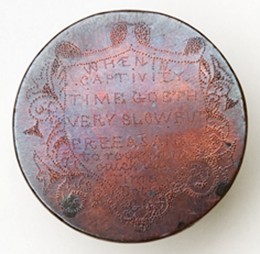
convictlovetokenIn response to yesterday’s post on trench art, one of Microkhan’s treasured Aussie readers turned us on to convict love tokens. These engraved coins were made by English convicts as they awaited deportation to Australia, during the island continent’s 19th-century turn as a massive penal colony. The token to the right was produced by an English baker who received a seven-year sentence for robbery; the cryptic (yet oddly hopeful) inscription, painstakingly engraved with a pin-like object, reads: “When in captivity time goeth very slowly, but free as air to roam how quick the time does go”.”

More on convict love tokens here. And definitely check out The International Center of Convict Studies, which features oodles of research on how Britain’s draconian imprisonment policies led to the creation of whole new societies.

Share

Comments Off on Convict Love TokensTags:···

The Umpteenth Angel of Death

April 3rd, 2009

One of the best magazine stories I’ve ever read is James B. Stewart’s “Professional Courtesy,” which first appeared in The New Yorker nearly a dozen years ago. The piece recounts the sordid tale of Michael Swango, a health-care worker whose favorite pastime was injecting elderly patients with lethal drug cocktails. Stewart tracked Swango’s whole career, starting with his early days as a paramedic who fed his comrades poison-laced KFC, and ending with a murderous stint in Zimbabwe. (The article was later expanded into a book.)

Ever since reading “Professional Courtesy,” I’ve had something of an unhealthy obsession with so-called Angel-of-Death cases. It’s an obsession that’s kept me quite busy, seeing as how these tragedies pop up with alarming regularity. Another one’s coming down the pike in Angelina County, Texas, where a nurse at a dialysis center stands accused of pumping several patients full of bleach.

The ubiquity of Angel-of-Death cases raises a chicken-or-egg question: does the health-care industry attract more than its fair share of murderous souls, or do otherwise ordinary folks develop their destructive impulses due to their constant proximity to death? According to a 2001 study, it’s all a question of opportunity:

When this information is combined with Kinnell’s observations on Shipman and Nesset, it begins to seem plausible that all walks of life have people with the potential to murder. The key difference may be opportunity. The features associated with risk noted above suggest that access and a low chance of observation are important. The difference between nurses and doctors may be that doctors also control the means of disposal—in the case of Nesset and Shipman, they also provided the death certificate. The reason for the difference in the number of reported deaths may simply relate to the doctors’ greater opportunity to remain undiscovered.

In other words, every industry has the same percentage of potentially homicidal maniacs in its workforce. Doctors and nurses just have more opportunities to act on their darkest impulses.

This raises yet another question: what percentage of any given population will harbor secret fantasies of murder? And, more importantly, how do I avoid these people?

Share

→ 4 CommentsTags:···

Art Amidst the Mustard Gas

April 2nd, 2009

bulletsculpture1Should any of y’all find yourselves near Doylestown, Penn., in the coming weeks, carve out a few hours to check out “From Swords to Ploughshares” at the James A. Michener Art Museum. The exhibit features 300 pieces of “trench art”—that is, baubles produced by 20th-century soldiers as they awaited their ghastly fates. Most of the gems come from World War I, and are cobbled out of empty shells, mustard-gas canisters, and whatever else the poor blokes could get their hands on. There’s something strangely heartening about these artworks—they’re a testament to mankind’s knack for creating pockets of sanity amidst the bloodiest chaos imaginable.

The Austro-Hungarian bullet sculpture atop this post comes from the collection of Gary Hollingsworth, the Orlando-based trench-art enthusiast who’s providing all the “From Swords to Ploughshares” goodies. More on his curious obsession here. Like so many great enterprises, it all started with a vacation in Budapest.

Share

→ 6 CommentsTags:····

Siberian of the Year

April 2nd, 2009

kseniasukhinovaJust six days remain in the annual “Siberian of the Year” campaign, so y’all need to get on it and vote. This year’s roster of candidates tilts heavily toward athletes, particularly Olympic champions and disturbingly bronzed bodybuilders. But the Frozen East also produces its share of artists, most notably the late Egor Letov (who would be honored posthumously). Microkhan was tempted to give Letov the nod, but we couldn’t resist casting our ballot for actor Eduard Ondar; we’re a bona fide sucker for anyone who plays Genghis Khan on the silver screen.

Knowing the way the human mind works, alas, Ondar probably doesn’t have much of a chance against reigning Miss World Ksenia Sukhinova. She is the pride of Nizhnevartovsk, a bleak oil town in the Khanty-Mansi Autonomous Okrug. I bet there’s a whole bunch of Nizhnevartovsk-ites stuffing the digital ballot box for her right now. And probably some horny Muscovites, too.

Share

Comments Off on Siberian of the YearTags:···

Islam, Music, and Splitting Hairs

April 2nd, 2009

Of all the Taliban’s attempts to drag Pakistan’s Swat Valley back into an imaginary Medieval Golden Age, the one Microkhan finds most baffling is the prohibition on music. In the West, it’s difficult to imagine religious observance (or secular life) without the accompaniment of music, that most universal of languages. But in the Swat Valley, the Taliban is reportedly going house-to-house, breaking folks’ flutes so they don’t dare play a note. (Some years ago, I remember reading the moving tale of a Kabul resident who risked death by playing his flute beneath a blanket in his own home.)

The question this brings up, of course, is whether Islam truly prohibits all forms of music, or if this is just some Taliban bastardization. As you might imagine, the holy texts are open to interpretation. And so much depends on punctuation and word choice. This snippet from a 2008 lecture by an Australian professor is instructive:

There is no explicit mention of music in Islam’s holy book: the Qu’ran.

However, in the Hadith (the collection of traditions and sayings attributed to the Prophet Mohammed), there are some passages which approve of and celebrate music, and others which denounce music. In some cases, a single passage can be interpreted in both, opposite ways.

Here’s a passage from the Hadith of Bukhari: “From among my followers there will be some people who will consider illegal sexual intercourse, the wearing of silk (clothes), the drinking of alcoholic drinks and the use of musical instruments, as lawful.”

For those who wish to use this quotation as evidence against music’s acceptability, the statement can be taken on face value – the use of musical instruments is part of a list of activities that should be considered unlawful. Surprisingly though however, this passage is also used to support the contrary position. The inclusion of the word “AND” in the phrase “drinking of alcoholic drinks AND the use of musical instruments” is taken to mean: music when used in combination with alcohol or licentious activities is unlawful.

Microkhan prefers the latter interpretation. Though given our crippling weakness for Crown Royal, we’ll just stick with our heathen ways.

Share

→ 4 CommentsTags:

Abraham, Ham

April 1st, 2009


Last week, Microkhan sang the praises of Surviving the Game, particularly the strong supporting work done by Gary Busey. We stand by that opinion, but we must confess there’s a reason that Ernest R. Dickerson’s 1994 action flick isn’t part of the mainstream cinematic canon. And that reason is the video above, in which the normally solid F. Murray Abraham chews up the scenery like a hungry pitbull gnawing on a T-bone. You half expect him to follow up by shouting, “Mendoza!”

Though we shouldn’t be too hard on Abraham. He earned a lot of residual goodwill for his turn as Salieri in Amadeus. And the dude’s great at getting flung out of a chopper.

Share

→ 2 CommentsTags:···

Phantoms of Industry

April 1st, 2009

coolingtowerSome of my favorite 19th-century paintings are those depicting mythological creatures (primarily fauns and satyrs) dancing amidst Roman ruins, presumably after downing several skins of plummy wine. So it follows that I’m also a big fan of artists like Harald Finster, whose focus is on the ghostly remnants of industry. His must-be-seen latest work has focused on abandoned collieries and steel plants throughout northern Europe; the picture atop this post is of a cooling tower at a desolate Dortmund steel mill.

My favorite Finster work, however, may be his series on the Overburden Conveyer Bridge F60, arguably the largest movable machine ever made by man. It was once used to excavate coal from the Lusatian countryside; it’s now a tourist attraction, for those curious geeks eager to see a metal structure even bigger than the Eiffel Tower.

Finster’s series on the bridge is here. And there are satellite photos, too.

Share

→ 5 CommentsTags:···

Police Appreciation Day

April 1st, 2009

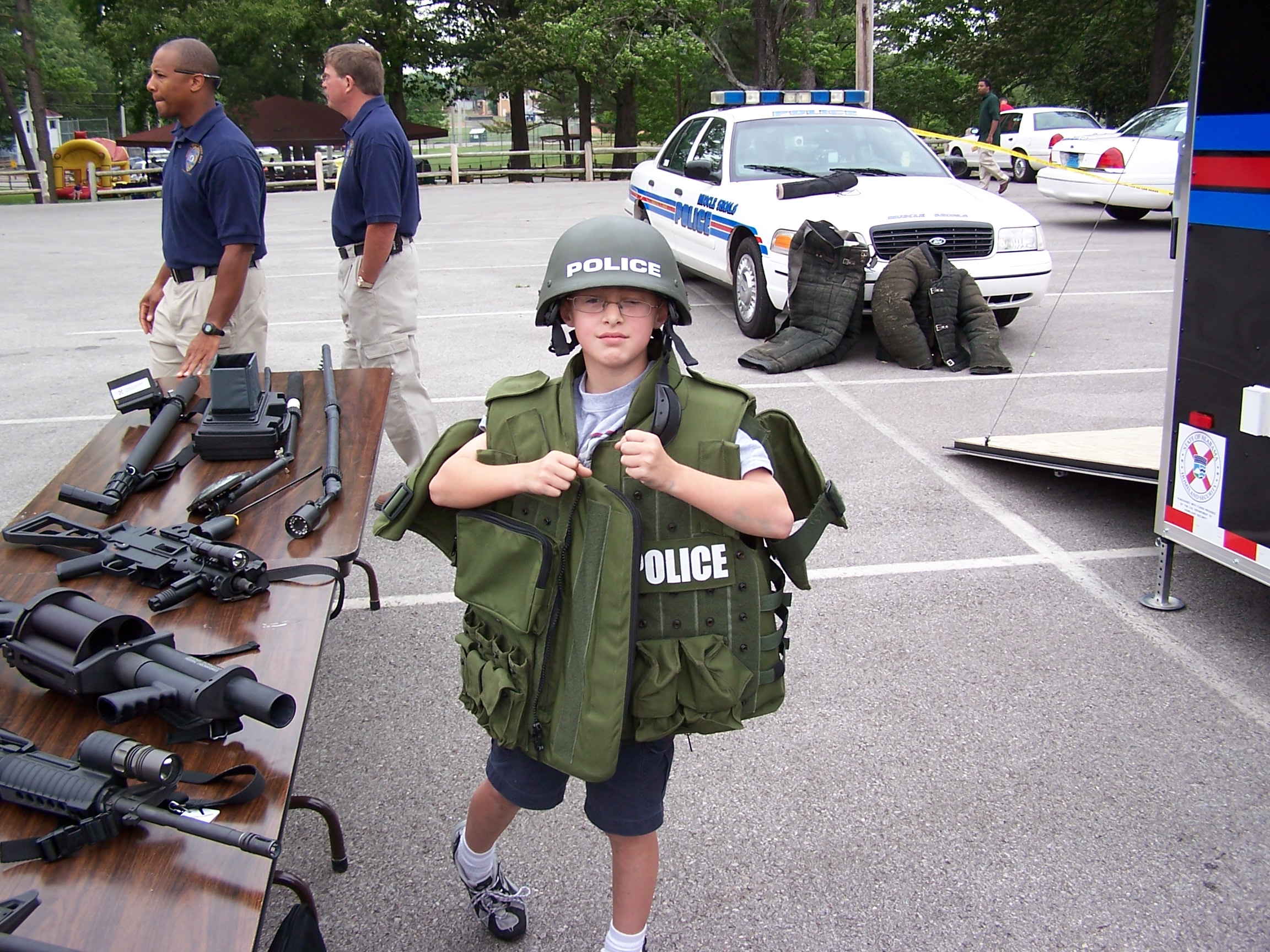
They sure start ’em young in Muscle Shoals.

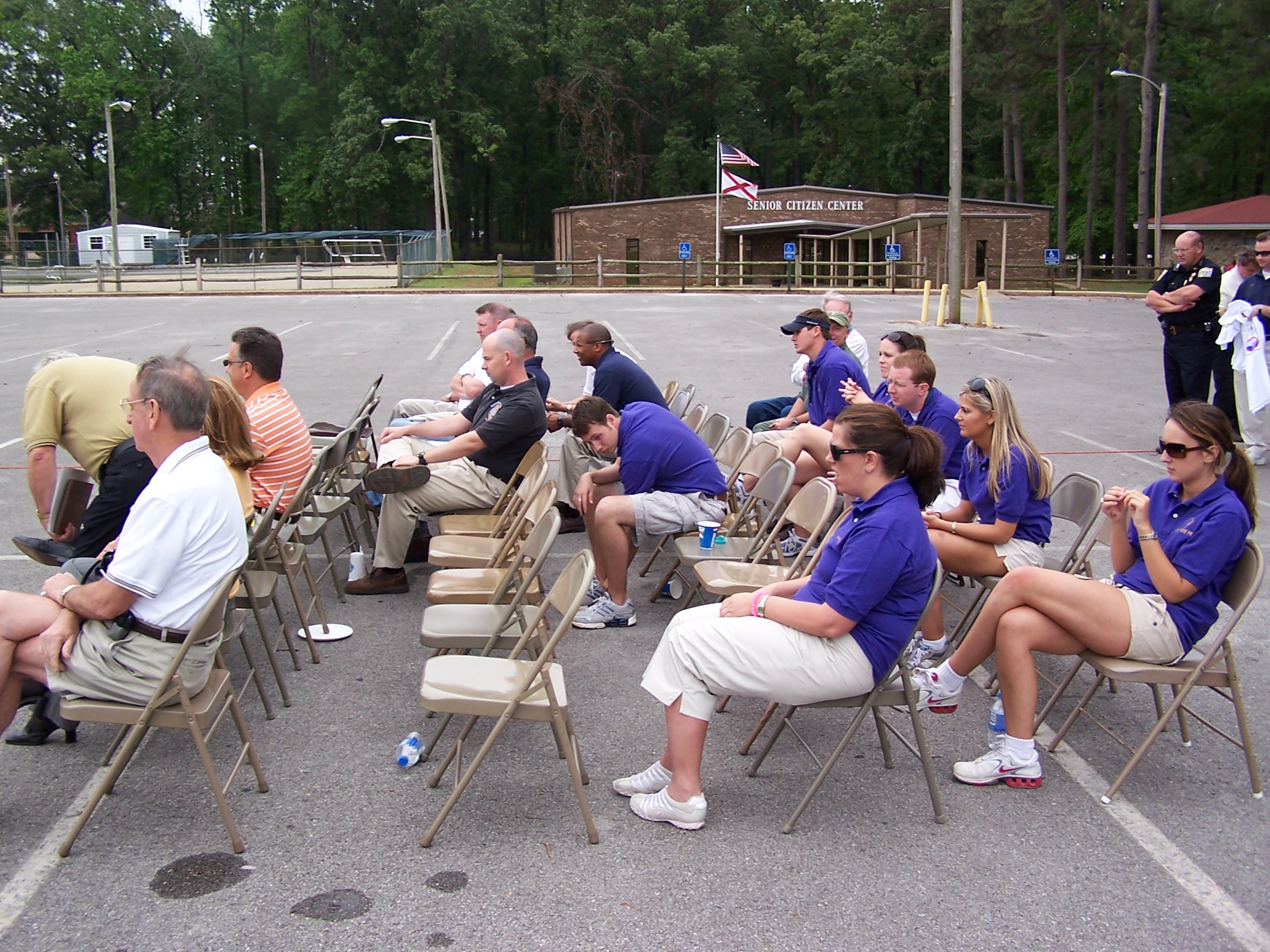
The full gallery is here. Is it just me, or do the University of Northern Alabama students look less enthused than advertised?

Share

Comments Off on Police Appreciation DayTags:·

The Queen of Sri Lankan Cinema

April 1st, 2009

malinifonsekaWith the 26-year-old Sri Lankan civil war continuing to wind down—or, at the very least, enter a decidedly less conventional phase—the Colombo government faces a big challenge: How do they bring the Jaffna Peninsula back into the national fold? The region has been dominated by the Tamil Tigers for years now, and the insurgents managed to set up a veritable independent country. (The Tigers were even organized enough to create their own traffic regulations.)
The key, of course, is the ensure the region’s economic viability—if folks are doing well, they’re far less likely to cause political trouble. (See: Northern Ireland.) But where to begin? Malini Fonseka, Sri Lanka’s most celebrated movie star, wants to build a national arts center in Jaffna, so that the peninsula’s capital will become a magnet for musicians, filmmakers, and other creative types. A noble gesture, for sure, but one complicated by Fonseka’s ethnicity: She is a member of Sri Lanka’s Sinhalese majority. As such, her films were verboten under the Tigers’ regime; they insisted that their subjects view Tamil-language movies produced in Kollywood. Will Jaffna’s denizens warm to Fonseka and her plans, or will ethnic suspicions undermine the endeavor? In war-torn Sri Lanka, alas, the smart money has to be on the latter right now.

More on Malini Fonseka’s storied career here.

Share

Comments Off on The Queen of Sri Lankan CinemaTags:···

“Playin’ Herself in Her Girlfriend’s Mink”

March 31st, 2009


Microkhan’s off to the (ugh) dentist, so that’s a wrap for today. But to make up for the bummer nature of the suicide post, we’ll leave you with a sonic treat: “Sally Got a One-Track Mind” by Diamond D & The Psychotic Neurotics, an underrated gem from hip-hop’s Golden Age. Okay, granted, the lyrics aren’t exactly uplifiting—Diamond D was a master of the sordid cautionary tale, and I’ve always wondered how Sally dealt with aging. But the beat will stick in your head, in a good way.

Share

→ 4 CommentsTags:··

The Puputans of Bali

March 31st, 2009

puputanMicrokhan’s few loyalists know that suicide is a frequent topic of interest ’round here. No surprise, then, that in the midst of reading Miguel Covarrubias’s Island of Bali, I was struck by the Mexican artist/ethnographer’s account of an infamous 1906 ritual mass suicide. Students of Balinese history (of which I’m certainly not one) are already quite familiar with the phenomenon of puputan, so apologies for serving up a familiar dish. But for those of us less acquainted with the self-slaughtering ways of defeated Rajas, it’s worth reading Covarrubias’s description.
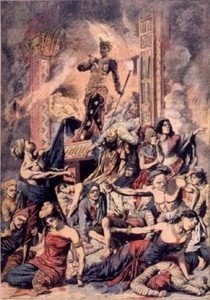
The quickie background is that the Raja of Denpasar realized that he could not withstand a Dutch assault, and knew that surrender would lead to exile. Since death outside of Bali was considered a one-way ticket to Hell, the Raja instead chose to slowly march his entire court into the teeth of Dutch firepower, while wearing their finest clothes and jewels. The results were not pretty, to say the least:

The wives of the Raja stabbed themselves over his body, which lay buried under the corpses of the princes and princesses who had dragged themselves over to die upon the body of their king. When the horrified [Dutch] soldiers stopped firing, the women threw handfulsof gold coins, yelilng that it was payment for killing them; and if the liberating bullet did not come soon enough, the maddened women stabbed themselves. When they had nearly all been killed, a new group approached, led by the Raja’s brother, a twelve-year-old boy who could hardly carry his spear. The interpreters again tried to stop them, but were ignored, and they were all shot down.

The account fascinates because, like so many modern folks, it’s impossible for me to imagine participating in a similar scheme. How many of us would choose, by our own free will, to give up life for the sake of a man we considered akin to a living god? Not for any great cause, mind you, but rather solely for the honor of dying alongside the one we venerate? Methinks one of modernity’s great achievements is the squelching of this mindset, which ranks as the very antithesis of individuality (a value we Americans prize above virtually every other). Yet Microkhan can’t help but admire the fortitude of the puputan‘s victims. Perhaps we’re hard-wired to be awed by self-sacrifice, no matter how seemingly irrational.

More on the 1906 Denpasar puputan, including some vintage photos, here.

(h/t Stranger in Paradise)

Share

→ 10 CommentsTags:····

The Epic Fail School of Espionage

March 31st, 2009

The full story’s yet to be told on why David Yen Lee, a longtime employee of Valspar Paint and Coatings, allegedly decided to betray a whole bunch of trade secrets to a Chinese competitor. Perhaps he’s suffering through a messy divorce, or he’s saddled with gambling debts. Or perhaps he’s just a greedy so-and-so who couldn’t help himself when a heaping pile ‘o lucre was laid on the table.

Whatever Lee’s explanation, we know this: They won’t be teaching his techniques to future corporate spies. It was bad enough that Lee used a data-copy program on a corporate laptop, and then stored the swiped files on a thumb drive at his home. (Where did you think the cops might look, Mr. Lee?) And it certainly wasn’t wise to buy a one-way ticket to China, after Lee told a pal that he was going to start a new life in the Far East. But Lee’s biggest bumble involved his apparent obliviousness to the fact that social networks are publicly viewable:

In addition to the thumb drive found, authorities said, Lee’s profile on LinkedIn, a professional networking site, proclaimed that he had quit Valspar and was now employed at “a major paint company in Asia.”

Mind you, this was apparently posted before Lee had even quit Valspar. Something tells me this guy would never have attained Putin-like prominence in the KGB.

Share

Comments Off on The Epic Fail School of EspionageTags:·····