Microkhan by Brendan I. Koerner

Microkhan by Brendan I. Koerner header image 1

The Coatesville Arsons

March 30th, 2009

coatesvillearsonsAfter at least 70 fires since the start of 2008, the Coatesville cops have a seventh suspected arsonist in custody. This time, it’s one of the city’s firefighters. A cause for relief? Hardly—the arsons have continued despite previous arrests, as well as the best efforts of the Chester County Arson Task Force. Why are some depraved Coatesville residents intent on burning their city to the ground?

This harrowing Philadelphia City Paper story provides some much-needed insight for those of us who only know Coatesville as Rip Hamilton’s hometown. The place doesn’t seem likely to give Disneyland any competition in the “Happiest Place on Earth” sweepstakes. And the city’s decline has fostered a certain eschatological mindset among its despondent denizens:

Until recently, Falaq ran a day care center. She had to shut down when some of the mothers got laid off. Struggling to find work, she reached out to various churches and charities, everyone but the welfare system, for help. But she couldn’t get any until she produced an eviction notice — physical proof of her desperation. Coatesville, she says, has tolerated its own desperation — the drugs, the shootings, the decay — for a long time. The families who’ve been burned out didn’t deserve it, of course. But spiritually, she wonders if the town needed this.

Read the whole piece, which also delves into the city’s tragic history of racial strife.

Share

Comments Off on The Coatesville ArsonsTags:···

The World’s Longest Hunger Strike

March 30th, 2009

Following on last week’s post on the British experience on Pakistan’s North-West Frontier, Microkhan will soon be exploring India’s struggles to deal with its own “tribal territories.” As a somber teaser, check out this account of the world’s longest hunger strike, being carried out by a Manipuri activist named Irom Sharmila. She has been fasting since 2000, during which time she has more-or-less been in constant custody:

For eight years, Sharmila has not consumed anything through her mouth and is force-fed a cocktail of vitamins, minerals, laxatives, protein supplements and lentil soup through the nose with a catheter. “She considers the rubber pipe as unusual but with time it has become natural to her. She practises Yoga for many hours,” said Babloo Loitongbam, a close friend of Sharmila and member of Human Rights Alert in Imphal.

Sharmila’s cause is an esoteric one, at least for outsiders: The repeal of the Armed Forces Special Powers Act. The Indian military says the Act is necessary to combat the dozens of militant groups that flourish in the nation’s North-East. The Act’s opponents counter that it gives Indian soldiers a free hand to torture and abuse.

There are lessons to be learned here about the management of the North-West frontier and other “tribal territories” in Asia. Stay tuned.

Share

Comments Off on The World’s Longest Hunger StrikeTags:······

Vanity Plus Guy in Cheap Gorilla Suit

March 30th, 2009

tanyasislandMy 13-month-old son and I just spent an exceedingly pleasant evening listening to WEFUNK Show 555, a chronicle of Paisley Park‘s Golden Age creations. If you have even a passing interest in the genius/megalomania of Prince, the show is highly, highly recommended—not just for the killer music, but also for the fascinating trivia provided by WEFUNK guest host Duke Eatmon.

Among Eatmon’s more fascinating tidbits is his mention of Tanya’s Island, a 1980 Skinemax-style film starring a young, extremely hot actress named D.D. Winters. She would soon be rechristened Vanity, and become the frontwoman for Prince’s first “girlfriend band,” Vanity 6. (She would also blow her shot at starring in Purple Rain by doing too much blow and sleeping with director Albert Magnoli.)

Words can scarcely do justice to the lunacy of Tanya’s Island. As best as I can figure, the film centers on a love triangle between Vanity, an abusive boyfriend/svengali named Lobo, and a gorilla who may or may not be imaginary. As this review explains:

Jealousy arises when Lobo discovers that Tanya is seeing someone else, even if he isn’t from the same species, and the fact that the ape pulled the head off his pet piglet doesn’t exactly endear the animal to him…The man goes to the lengths of trapping [the gorilla] in a cage and demanding that Tanya accompany him to the other side of the island, but she refuses and frees the ape. Lobo then plumps for the alternative, caging Tanya in his quickly constructed fort. Violence follows.

As does interspecies sex, apparently. View at your own risk. Or just skip the whole filthy enterprise and watch Vanity’s true masterpiece, the legendary “Nasty Girls” video.

Share

→ 7 CommentsTags:····

“…Are Doomed to Repeat It”

March 27th, 2009

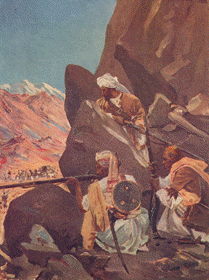
nwfrontierAs we prepare to ramp up Operation Enduring Freedom, as well as focus more intently on the Taliban’s Pakistani havens, it’s worth looking back at the British experience in the Graveyard of Empires. Of specific interest is the classic 1898 account The Risings on the North-West Frontier, a detailed account of several expeditions carried out in the so-called tribal areas. Then, as now, the military campaigns were meant to pacify a people who threatened Western security interests. And then, as now, the Westerners found it nearly impossible to achieve total victory, despite their technological superiority. A telling quote from the book’s conclusion:

Our enemies, wherever encountered, have been punished, and their losses are stated on unimpeachable evidence to have been extremely severe. The towers and walls of almost every fortified village in the country have been levelled to the ground, and the winter supply of grain, fodder and fuel of both tribes has been consumed by the force. The Orakzai have been completely subdued and have complied with the terms prescribed for them; but the Afridis still hold out, although I have strong hopes that they may before long submit and thus save their country from a fresh invasion in the spring.

In other words, mission incomplete. And the Orakzai? They’ve hardly stayed subdued, judging by their recent machinations.

The whole book is worth a read, as is this illustrated laymen’s summary.

Share

→ 8 CommentsTags:····

In Post-Soviet Russia…

March 27th, 2009


…cops evidently go the extra mile with their community policing methods. Sorry, couldn’t quite conjure up a killer Yakov Smirnoff punchline out of this clip of Russian cops going all Michael Phelps. Free Microkhan t-shirt to anyone who can.

Share

→ 8 CommentsTags:··

Dehorning Paste Smackdown

March 27th, 2009

dehorningpasteLiving here on the cramped island of Manhattan, where “nature” amounts to little more than the trees in Marcus Garvey Park, it’s easy to feel disconnected from our ranching brethren out West. So I occasionally try and force myself to get in touch with the ways of livestock management, the better to appreciate the care and technology—yes, technology—that goes into my occasional plate of dibi.

While recently perusing this detailed compendium of must-have goat-ranching supplies, I came across a mention of Dr. Naylor Dehorning Paste. It’s basically a simple preparation of lye and lime that, when applied to the heads of young livestock, prevents horns from ever growing in. This ostensibly eliminates the need for dehorning later in life, a process that involves some extremely scary-looking instruments.

It turns out that Dr. Naylor has something of an arch-nemesis in Dr. Larson’s, the other leading manufacturer of dehorning paste. Both have been around for upward of six decades, and were founded by real-live veterinarians (rather than fictional mascots such as Tipsy McStagger). Who makes the superior dehorning paste? Microkhan hopes his more livestock-inclined readers might answer that for the rest of us.

More on Dr. Howard “Wing” Naylor here. And a first-hand account of his product’s efficacy here. (Warning: Potentially objectionable material for vegetarians.)

Share

→ 3 CommentsTags:····

Burmese Voodoo

March 27th, 2009

Lost amidst the week’s more high-profile news was something quite significant, at least for those of us keen on Asian affairs: a (relatively) high-level State Department official dropped in on Burma, in order to feel out the ruling junta’s openness to dialogue. Stephen Blake made a rare visit to Naypyidaw, the junta’s somewhat creepy jungle capital and a longtime Microkhan obsession. For those who don’t closely follow Burmese affairs, the nation’s government relocated from Yangon to Naypyidaw a little over three years ago, allegedly on the advice of dictator Than Shwe’s astrologer. Photos like these make the prefab city seem mighty sinister—not too surprising, given that it was built with slave labor.

I reckon an old Asia hand like Mr. Blake is aware of the depths of Than Shwe’s voodoo-tinged paranoia. If so, I wonder if he inspected his Naypyidaw hotel room:

Whenever a UN envoy visits Burma, hotel staff are told to install a strip of a pregnant woman’s sarong or underwear within the ceiling of the VIP’s suite. Traditional Burmese men are often superstitious that coming into contact with women’s undergarments will diminish their hpoun, or manly power.

Microkhan narrated a Magnum Photos slideshow on Burma last year. And we heartily recommend Emma Larkin’s Finding George Orwell in Burma for further reading.

Share

Comments Off on Burmese VoodooTags:··

The Dog Ate Our Server

March 27th, 2009

sorryApologies for the slow start today. Our Utah-based host has been down most of the morning, and is only now returning from the dead. A post on Burma got chewed up in the shuffle; starting over from Square One right now.

Do not despair, loyal readers. (Both of you.) You’ll get your full complement of polymathism soon enough. Promise.

Share

Comments Off on The Dog Ate Our ServerTags:

The Rasputin of Madagascar

March 26th, 2009

didierratsirakaThe story out of Madagascar continues to both stymie and amaze: A 34-year-old DJ-turned-mayor suddenly becomes president of a nation of 20 million, in one of the murkiest fashions possible. Microkhan has previously guessed that a shady Korean land deal played a role in bringing Rajoelina to power—along with the ongoing mismanagement of the deposed Marc Ravalomanana, who apparently did little to lift Madagascar out of poverty.

But a friend of Microkhan with Madagascar connections has offered a different theory: Rajoelina’s coup was made possible by the covert of support of Didier Ratsiraka, Madagascar’s longtime strongman now living in exile in France. Ratsiraka was convicted in absentia for fraud, and so would have been sent to prison for ten years had he returned during Ravalomanana’s reign. But early signs point to Rajoelina being the more forgiving sort: he has pardoned all political prisoners, and counts several Ratsiraka advisers among his closest staffers. Then there’s this, from the Indian Ocean Newsletter (subscription only):

The former mayor of Toamasina, Roland Ratsiraka (the nephew of ex-President Didier Ratsiraka) coordinated from the wings the fight against President Marc Ravalomanana in the East of Madagascar, his family’s traditional stronghold. He was also the person who had persuaded several officers in the Malagasy army to rally behind Andry Rajoelina. Roland Ratsiraka will now try to regain his place as the political leader in the East of the country. A place that Ravalomanana had done all he could to oust him, not without some success.

There are already rumblings that Ratsiraka is contemplating a trip home. Will he become the aged power behind the throne?

Share

→ 2 CommentsTags:··

The Bulldog and the Birthmark

March 26th, 2009


My recent movie diet has mostly consisted of classy fare—I doubt Bridge on the River Kwai played many double bills with the likes of Switchblade Sisters. But Microkhan is by no means a film snob, and likes the occasional semi-brainless action flick as much as the next pint-sized Mongolian monarch. Case in point: Ernest R. Dickerson’s criminally underrated Surviving the Game.

The movie is a spin on The Most Dangerous Game, with a heavily dreaded Ice-T playing a bum who’s conned into becoming human prey. The hunters are a Who’s Who of great character actors: Rutger Hauer, Charles S. Dutton, F. Murray Abraham, and, best of all, Gary Busey. An actor infamous for once snorting cocaine off his dog, Busey absolutely kills it here as a psychiatrist with, uh, “issues” of his own. The “Prince Henry Stout” monologue above is arguably the pinnacle of Busey’s storied career—as well as a warning to future parents on how not to usher your adolescent sons into manhood.

Share

→ 6 CommentsTags:··

Subways and the Smart Grid

March 26th, 2009

seoulsubwayAs promised yesterday, Microkhan’s gonna continue with its week-long series of “extras” taken from the cutting-room floor of my Wired smart-grid essay. Today’s treat? How subways can become part of distributed-generation networks, along with rooftop solar panels and backyard wind turbines.

Beginning in the early 1970s, the Metropolitan Transit Authority began experimenting with flywheels that can capture the energy produced by subway braking. (About 60 percent of the heat in the subway tunnels stems from screeching brakes.) The idea is for that energy to then be pumped back into the system, so that the subways can reduce their grid dependence.

The New York flywheel experiments continue, evidently to little effect. Meanwhile, however, cities like Seoul and Beijing seem to be making progress. The Korean experiment, which relies on ultracapacitors, seems especially promising, since the the limits of battery technology have been an impediment to regenerative braking. (Though my colleague Vince Beiser contends that supersized batteries are no longer a pipe dream.

Once the capture and storage details get ironed out, the next question is whether some of that energy can be funneled into the grid, rather than kept locked inside the transit system. In other words, would there be an economic advantage to selling that power to utilities? Could the resulting markup be used in part to fund transportation projects—or, at the very least, keep our fare from constantly spiraling upward? At least one learned scholar I talked to favors the distributed approach, though perhaps not in New York—our century-old system, alas, may be too complex a beast to take part in the coming alt-energy revolution.

Share

Comments Off on Subways and the Smart GridTags:···

The Greening of Shipbreaking?

March 25th, 2009

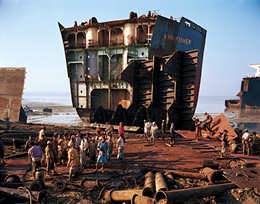
shipbreakingA surprise court decision in Bangladesh may shutter the nation’s vast shipbreaking industry, at least temporarily. The judges were swayed by arguments made by the Bandladesh Environmental Lawyers Association, who have long contended that the industry is among the planet’s dirtiest. Indeed, you probably don’t want to know what happens to the guts of a chemical tanker after a couple decades on the high seas.

But is there a greener way of scrapping ships? The British are trying to give it a go in Liverpool, ushering the HMS Intrepid into that sweet goodnight.

More stunning images from Bangladesh’s shipbreaking industry here and here.

Share

→ 3 CommentsTags:···

Rubbed the Right Way

March 25th, 2009

therubI’m a bit embarrassed to admit this, but it took a tip from a Zurich-based pal to get me into The Rub’s History of Hip-Hop series. I mean, these Rub folks live less than an hour away from my Atlah headquarters. They should be part of the cultural air I breathe. But, oh no, it took a denizen of north-central Switzerland to pass the word. So things go in the Age of The Tubes, I reckon.

In any event, glad young Mr. Kennedy offered the lead, because the series is great—nearly two dozen mixtapes, organized according to year. They’ve been my constant companions during my morning runs; for some odd reason, hearing a pre-fame Talib Kweli discuss “wishing well water imported from Pluto” got me through a tough fifth mile the other day. The whole series is highly recommended, starting with Volume 17 (MP3).

Share

→ 2 CommentsTags:···

The Sludgy Pleasures of Zu

March 25th, 2009

nagazuThe Nagas of the India-Burma border region are especially dear to my heart, seeing as how they play a pivotal role in Now the Hell Will Start. They were always gracious during my travels through the Patkai Mountains, despite facing myriad problems of their own (beginning with a tenuous security situation). And a big part of their hospitality includes the doling out of zutho, or zu, a cloudy rice beer that is the Bud of the Indo-Burmese jungle.

Zu gained much renown among British explorers, who could only carry so much gin with them on expeditions. (Perish the thought that a surveyor of the raj spend a single night sober.) Yet the brewing process has long remained a closely guarded Naga secret, akin to Colonel Sanders delicious blend of herbs and spices.

But, oh, how scientists have tried to unlock the tipple’s secrets. In 2002, a pair of Japanese microbiologists collected a zu sample from just outside Kohima and subjected it to all manner of high-tech tests. They succeeded in identifying the active yeast, Saccharomyces cerevisiae, which is also used in many Western-style ales. The microbiologists also struck a somewhat dismissive tone about zu‘s potential mainstream appeal, describing it as a “a whitish porridge-like slurry containing 5.0% (v/v) ethanol.”

In my own experience, zu is much thinner than oatmeal, and more akin to nigori sake than anything else. It actually has a surprisingly light, crisp taste, with just a hint of effervescence. As for the alcohol content, the Japanese seem to have received a bum batch—a night of zu caused me a hangover of Bukowiski-esque proportions. I’ve only felt that bad once since, after mistakenly experimenting with this.

Share

→ 2 CommentsTags:····

“Sleek Greyhound of the Seas”

March 24th, 2009

oceanliner
Over the weekend, the fam and I paid a visit to the Museum of the City of New York, primarily to check out the exhibit on our fair city’s stab at going green. But the exhibit that really drew me in was “Trade”, an overview of New York’s heyday as a bustling port. As noted yesterday, Microkhan has enjoyed a lifelong fascination with polyglot commercial centers—or, as the Obi-Wan might put it, “hives of scum and villainy.”

Among the gems at “Trade” was a mock-up of Norman Bel Geddes‘s proposed luxury liner. Geddes’s big idea was to completely get rid of deck space, so that transoceanic passengers wouldn’t breath a lick of fresh air between New York and points far afield. He didn’t mean this to be cruel, but rather to increase speed—his theory was that deck’s caused massive drag, and that getting rid of them going with the torpedo design would increase speed by upwards of 50 percent. Guess we’ll never know if that man was correct, since this beauty never even got into beta.

More on Geddes’s prototype here.

(h/t David Szondy)

Share

→ 2 CommentsTags:····

Dinosauring the Sandbag

March 24th, 2009

portablewallThe humble sandbag remains mankind’s main line of defense against floods. Take the current situation in Fargo, N.D., where upwards of 10,000 Good Samaritans are furiously filling bags in order to combat the rising Red River. Working around the clock, the volunteers have so far managed to deploy about 70 percent of the requisite sandbags—seemingly good news, save for the fact that Mother Nature will not be repelled by anything less than 100 percent coverage. She’s crafty like that.

But North Dakotan officials are trying out a secret weapon: Hesco Bastion’s Concertainer, a portable wall system that makes sandbagging seem like weaving on a loom. Over a thousand yards worth of wall can be unspooled in under an hour; the empty partitions are then filled with sand, preferably using industrial machinery. But even going the ol’ shovel route is faster than filling sandbags, since there’s no need to tie off then set down after each bag is filled.

The Concertainer was recently used to protect Operation Enduring Freedom soldiers from sniper attacks. Will it work against the Red River, too? Water moves a bit slower than a bullet, but it has its ways of forcing the issue.

Share

→ 4 CommentsTags:····

The Smart Grid (Hopefully) Cometh

March 24th, 2009

electriccompanyAfter a wait that seemed ever-so-slightly like forever, Wired‘s cover package on smartening up the electric grid is finally here. I wrote the lead essay, which is mostly a primer on how the grid got so FUBAR in the first place. The bite-size answer? Myopia, botched deregulation, and political bickering.

It was difficult to even address the tip of the smart-grid iceberg in 2,000 words, so a heckuva lot ended up on the cutting-room floor. For the remainder of the week, I’ll be offering exclusive smart-grid tidbits here at Microkhan—the geek-blog equivalent of DVD extras, as it were. Today’s dish, from one of the essay’s earliest drafts: the perils of distributed generation.

For the uninitiated, distributed generation means jacking backyard and rooftop generators (e.g. solar panels and wind turbines) into the grid. This will allow regular folks to sell green power to the likes of Con Edison. A fabulous idea, but one that could be done in by the trickiness of matching phases between the homebrew electricity and the stuff already coursing through the grid. A great quote that fell by the wayside:

“If a 50-story Time Square apartment building starts pumping out power the wrong way, it can disrupt the power in the city pretty quickly,” says Roger N. Anderson, senior research scholar at Columbia University’s Center for Computational Learning Systems.

In other words, distributed generation is hardly plug-and-play. The solution is software that’s placed at the gateway between buildings’ internal systems and the grid at large. That’s what Anderson and his cohorts are working on—and, one would hope, the smart-grid wizards at the likes of General Electric. How sweet it would be to bill Con Ed for buying my solar juice, instead of paying that mammoth Con Ed bill for slurping down burnt coal.

More smart-grid extras throughout the week, so stay tuned. In the meantime, check out a vintage Electric Company clip here.

Share

→ 1 CommentTags:····

Chewbacca Looks Reluctant

March 23rd, 2009


After playing Captain Bringdown with all the suicide talk, I thought I owed it to y’all to post something a bit more lighthearted. I’m in the midst of doing some groundwork for my next book, which deals a lot with global trade during the waning days of the British Empire. This research has led me to give a lot of thought to the original Star Wars, particularly the Mos Eisley scenes. I trace my lifelong love affair with knowledge to that polyglot cantina. There was just something about the intersection of crime, commerce, and exotic cultures that tugged at my pre-school heart.

As such, I was motivated to dig up the above gem—the stars of Star Wars guesting on The Muppet Show. Judging by Mark Hamil’s uniform, this must’ve been to shill for The Empire Strikes Back.

The whole show (or at least all the Star Wars-related bits) can be seen here. I had this thing on Betamax back in the day, and literally wore out the tape from playing it so much. I was especially fond of Gonzo’s dark turn as Lord Vader.

Share

→ 5 CommentsTags:···

“A Prohibition So Divine…”

March 23rd, 2009

A couple of weeks ago, Microkhan delved into the apparent link between literacy and suicide—the more literate a nation’s population, it appears, the likelier it is to have a high suicide rate. This theory might explain in part why so many post-Soviet nations have serious suicide problems—their citizens are well-educated, but also struggling economically (at least compared to the West).

A commenter on the post, however, had a different take, which merits addressing:

How about the legacy of the eradication of the church from these areas? This would seem a far more likely connection.

Fair point. The Soviet Union was notoriously hostile to organized religion—opium of the masses and all that. Also, it’s been pretty well-documented that frequent worshippers are less likely to off themselves than their non-churchgoing pals. (The classic study on this topic looked at Mormons of varying commitment levels in Utah.) Does that axiom apply to entire nations, rather than just individuals?

This 2008 Gallup poll, albeit flawed, suggests that it does. A lot of post-Soviet nations show up at the bottom of the table, with low religiosity and high suicide rates. And devout nations such as El Salvador, Nicaragua, and Mauritania rank near the top, despite their relative poverty (commonly thought to be a prime cause of self-slaughter).

Yet there are also two notable outliers: The U.K. and The Netherlands. Both are decidedly secular, and both have suicide rates far below the global average. One also can’t help but notice that warm-weather countries crowd the top of the table, while chilly locales cluster near the bottom. So perhaps Seasonal Affective Disorder (and its sinister cousin, alcoholism) play a bigger role in suicidal ideation than most folks realize. (Fodder for another Microkhan post, for sure.)

As is so often the case in debates over the merits of religion, your conclusion will vary according to your faith (or lack thereof). Microkhan’s quick (and geeky) take is that there’s likely an evolutionary reason for organized religion’s development, and that its ability to sustain some folks through the otherwise unbearable is nothing to sneeze at. At the same time, suicide rates seem linked to cultural norms that are independent of religion—look at a country like Japan, where suicide has a long and ignoble history. And my hunch is that the U.K.’s low rate is somehow correlated to the whole “stiff upper lip” ethos, which also sustained the Empire’s hearty foot soldiers through malaria, scurvy, and spotted dick.

The surefire way to settle this debate would be to look at, say, Latvian suicide rates before and after the nation’s acquisition by the Soviet Union. But the odds of such statistics existing are somewhere between slim and none; in bygone days, who had time to compile accurate morbidity stats when there was grain to harvest?

The bottom line is that, yes, if many folks in a country fear the hot fires of Hades should they take razor to wrist, that country’s suicide rate will probably be a tick lower than the norm. But if Belarus et. al. want to cut down their suicide rates, encouraging religious devotion probably isn’t the most efficient way to go; they’re better off doing what they can to prevent the average hard-working citizen from living in squalor.


Share

→ 3 CommentsTags:··

Turtle Farming on the Bayou

March 23rd, 2009

ninjaturtleOur nation’s turtle farming industry recently received some rather unwanted attention, courtesy of Operation Shellshock. The multistate investigation uncovered a clandestine network of reptile smugglers, whose dastardly deeds included the peddling of rare turtles to both collectors and Chinese diners. The scheme was allegedly abetted with “the help of a corrupt Louisiana turtle farm,” which hid endangered specimens amidst its more ordinary residents. (A meat processor on Maryland’s Eastern Shore may also be in legal hot water).

That news is sure to upset 60-plus legitimate turtle farmers, who’ve put up with plenty over the years. In 1975, due to a salmonella scare, the Feds banned the interstate transport of turtles whose shells measure less than four inches in diameter. Since then, there’s been virtually no domestic market for turtles; the Louisiana farmers export virtually everything to Asia, particularly the turtle-loving coastal regions of China. The farmers have tried myriad times to get the U.S. ban lifted, pointing out salmonella has mostly been eradicated thanks to the scientific efforts of Ronald Siebling, a professor of immunology at Lousiana State University. (Siebling’s method involves the injection of antibiotics into early-stage eggs.) But Uncle Sam has turned a deaf ear, and the Louisiana industry consequently remains just a blip—its 10 million turtles are estimated to have a total value of just $5 million.

More on Louisiana’s efforts to reopen the domestic turtle market here. The state’s biggest operation is Concordia Turtle Farms, run by “Uncle” Jesse Evans (who competes for the title of “The Turtle Man” with this guy).

There’s also a big turtle farming industry in China. Naturalists are none too happy with its callousness, it seems.

Share

→ 3 CommentsTags:·····

Greatest Team Nickname Ever

March 20th, 2009

sanmiguelbeermenI’ll confess to getting a bit choked up when watching the closing seconds of any March Madness game. CBS always pans across the defeated team’s bench, revealing a bunch of dejected seniors whose careers have suddenly evaporated. Most will move on to high-level rec leagues, and to boring their children with exaggerated tales of their hardwood exploits.

Yet a few lucky souls will earn a living playing the sport they love. To make that happen, some will bid farewell to the U.S. and journey to The Philippines, home to the second-oldest professional league on the planet. That’s what former Coppin State standout Dorian Pena did after college. Now he’s the go-to big man for the San Miguel Beermen, arguably the most splendidly nicknamed team in pro sports history (right behind the Nippon Ham Fighters). The Beermen are also the best team in the league right now, largely thanks to devastating accuracy from beyond the three-point arc.

Despite the Philippine Basketball Association’s lengthy history, the league doesn’t attract much top-flight American talent. The best-known foreign “import” at present is probably Jai Lewis, a star on that George Mason team that made an improbably Final Four run back in 2007. He currently plays for the Rain or Shine Elasto Painters.

There’s only one PBA team without any Americans: The Pure Food Tender Juicy Giants. Um, on second thought, perhaps that’s the best team nickname ever.

My hunch is that the PBA gets bought out by the NBA in the next 15 years, and becomes a conference within NBA Asia. You just know David Stern licks his chops when he reads stories like this.

Share

→ 9 CommentsTags:····

What Was Lea Thompson Thinking?

March 20th, 2009


Another Friday, another end-of-week paean to terrible movie reviews. This time, instead of digging though the proverbial crates, Microkhan would like to cite the A.V. Club’s recent take on the Howard the Duck DVD release:

Finally, the book can be closed on the DVD era: Howard The Duck, a George Lucas production every bit as ignominious as Jar Jar Binks, has now been made available to the tens of fans clamoring for its release…More than 20 years later, Howard The Duck remains a black hole, unsalvageable as camp, as ’80s curio, or so-bad-it’s-good classic. It’s where entertainment goes to die.

I remember really, really wanting to see this back in the day—in large part because I had a schoolboy crush on Lea Thompson, fresh off her career-making role in Back to the Future. Judging by the sheer awfulness of the clip above, my parents’ decision not to expose me to Howard ranks as one of their best moves.

Jordan Prentice, one of the half-dozen Little People who played Howard, later starred in Harold & Kumar Go to White Castle. He played the Giant Bag of Weed.

Share

→ 4 CommentsTags:···

The Miracle of Concrete

March 20th, 2009

Sometimes the simplest measures can improve public health in the most remarkable ways. Want to save hundreds of thousands of young lives each year, while improving those kiddos’ IQ scores to boot? Cover their floors with concrete.

Share

Comments Off on The Miracle of ConcreteTags:

The Risks of Prison Wine

March 20th, 2009

prunosweatshirtIf you’re looking for proof of mankind’s inveterate need for altered states of consciousness, look no further than pruno. Long created beneath the bunks of prison inmates, and often consisting of such odious ingredients as ketchup and sauerkraut, pruno is notoriously unpalatable, even for the most hardened toughs. According to a participant in a harrowing 2006 taste test, the stuff is reticent not of black currant and cinnamon, a la Spain’s finest riojas, but rather “a rotten compost heap of tropical fruits consumed by maggots.”

But it’s not just the terrible taste that inmates must contend with. According to a new CDC study, recent batches of pruno have been found to be rife with botulism—yeah, the stuff that gets injected into Nicole Kidman’s face on a semi-daily basis, but was once better known for killing people.

Fortunately for pruno aficionados, they can probably avoid botulism by eschewing potatoes in their recipes. According to the CDC, that was the likely culprit in a 2004-2005 California prison outbreak. Inmates of America, live by this code: Potatoes are for making decorative stamps, not for turning into mind-erasing quasi-wine.

(h/t on sweatshirt photo to Ultimate Fight Shop)

Share

→ 3 CommentsTags:····

“Supply…and Demand”

March 19th, 2009


I’ve got to buckle down for the rest of the day and focus on the Now the Hell Will Start screenplay, so this’ll be my outro post for March 19th. If you’ve never experienced the ecclesiastical comedy stylings of Father Guido Sarducci, you’re in for quite a treat. Here, he discusses his million-dollar idea for the Five Minute University—an institute of higher ed that teaches you only what the typical college student remembers five years after graduation, and thus packs four years’ worth of book learnin’ into a mere 300 seconds. Your business class? “Buy something, and then sell it for more.”

Oh, and you gotta love Padre S. for appearing on those Handsome Boy Modeling School albums. Dan the Automator won’t work with just any priest, y’know.

Share

→ 3 CommentsTags:··

Vermont’s Baby Bust

March 19th, 2009

vermontcoinThe most widely discussed aspect of the latest national birth figures is the sheer number of babies that dropped in ’07—more than in any year since the late Eisenhower administration. Well, that and the fact that 40 percent of those births were out-of-wedlock—the result of more and more women getting preggers without getting hitched.

But what struck me about the figures was Vermont’s position in the birth-rate cellar. I figured that, given the egregiously long winters in the Green Mountain State, folks would have nothing better to do than make babies from November ’til the spring thaw. But the average Vermont woman has less than 1.6 kids over the course of her lifetime—well below the replacement rate of 2.1, and seriously bad news for the state’s future economy. Those trees won’t tap themselves for maple syrup, you know.

What’s left unexplained in all the press coverage is why Vermonters are so keen to resist the Siren’s call of parenthood. So let’s dig a little deeper, shall we? The two main factors that adversely affect birth rate are affluence and education. (Age, of course, is another, but we’ll disregard that because of its chicken-or-egg nature.) The richer and more highly educated a population, the lower its birth rate tends to plummet. That’s why Japan and Italy are worrying about their forthcoming demographic dips—prosperity plus lots of degrees equal a dwindling population.

In the case of Vermont, the education factor definitely comes into play; the state is often ranked as the most highly educated in the land. But that education hasn’t necessarily translated into higher income, as Vermont ranks in the middle of the pack, below the likes of Delaware, Virginia, and even Wyoming.

And therein lies an opportunity for Vermont to develop an effective pro-natal policy. Higher education—particularly post-graduate education—is a drag on birth rates because being a student isn’t conducive to being a parent. You’re broke, you’re overwhelmed with time-intensive work, your future job prospects are shaky. But the time you get sheepskin in hand and a job (hopefully) squared away, your already late to the family game.

Rather than conjure up a series of minor tax breaks (the typical pro-natal strategy in state capitals), Vermont should think of some ways to encourage students to start families: Tuition breaks, day-care services at state universities, better wages for TAs, night and summer job placement, etc. Yeah, it’ll be expensive, but it’s a worthwhile investment if it’ll prevent your state from becoming one big retirement home. And as fate would have it, isn’t a whole bunch of that stimulus money supposed to go towards higher ed?

Alternately, perhaps Vermont could experiment with starting a public-access porn channel. Or, if legislators want to keep it clean, figure out a way to lure immigrants from Utah.

Share

→ 2 CommentsTags:··

Light Rail in Lagos

March 18th, 2009

lagosblueline
After a lengthy bidding process, the two-line Lagos Rail Mass Transit project is set to break ground in September. This comes on the heels of the successful revamp of the city’s bus service, which now carries 180,000 passengers per day.

Can the rail project ever come to fruition in a city as chaotic (and chronically misgoverned) as Lagos? There are plenty of skeptics, given the recent failure to build two regional lines amidst charges of corruption. And, of course, whenever I hear about transportation in Lagos, I can’t help but think back to George Packer’s New Yorker piece from 2006, in which he described the life of an agbero—a transportation worker whose sole job is to negotiate payment disputes between riders and bus drivers.

More on the Lagos rail project here, from “Nigeria’s most widely read newspaper”.

Share

Comments Off on Light Rail in LagosTags:···

From the “Where Are They Now?” File

March 18th, 2009

loubondIt’s frightening to think how many hours I’ve spent listening to WEFUNK Radio over the past seven or eight years. I’ve doubtless heard every archived show at least twice, and several of them close to a dozen times. (Neophytes should start out with Show 170.) WEFUNK, broadcasting weekly from Montreal’s famous Lou Bond, who has a single Stax recording to his name. The show recently spun Bond’s “To the Establishment”, and I was immediately—the classic Siren Effect, in effect. Ever since, I’ve been dying to know what happened to Bond, and why his recording output was so limited. Been coming up snake eyes so far, but who knows? Perhaps one of Microkhan’s loyal readers has the scoop. Anyone? Would be great if this guy could have a renaissance, a la Brian Wilson.

More on Bond here, from the priceless Funky16Corners.

Share

Comments Off on From the “Where Are They Now?” FileTags:··

Last of the Morans

March 18th, 2009

In the early part of this decade, the fair city of Melbourne, Australia was embroiled in a violent gangland war, pitting a speed trafficker named Carl Williams against the notorious Moran clan. The spat, which started when one of the Morans shot Williams in the belly, ended up claiming at least 34 lives; it also became a lurid topic of fascination among Australians, as well as fodder for a top-rated crime series.

The bad old days supposedly ended years ago, when Williams was sentenced to life. But someone’s apparently not content to let bygones be bygones; last night, this dead-ender tried to off the last male Moran. Des “Tuppence” Moran somehow survived unscathed, which makes him a great deal luckier than his brothers and cousins:

The Moran family was almost wiped out in the underworld war. Judy’s son Mark Moran was gunned down outside his Aberfeldie home in 2000. Her son Jason was shot dead in front of his children at an Auskick football clinic in Essendon in 2003. And her husband Lewis was shot dead by Evangelos Goussis at the Brunswick Club in 2004.

Salacious! And yet as is so often the case, the notoriety of the Melbourne gangland wars—pumped by the tabloid press—obscures the fact that the city’s extremely safe, with a current murder rate of 7.4 per 100,000 residents. In other words, it ain’t no Caracas—or even a Port Moresby, for that matter.

Share

Comments Off on Last of the MoransTags:·

Upset of the Year

March 17th, 2009


With March Madness about to commence, you’re likely to hear a lot about mammoth upsets in the coming days—no hyperbole will be spared when a 14-seed inevitably knocks off the likes of Wake Forest or Gonzaga. But such triumphs pale in comparison to what went down in Gainesville, Florida over the weekend, when Bob Tasca III won the Funny Car division of the ACDelco NHRA Gatornationals. It was Tasca’s first professional win, and it came against no less august an adversary than the legendary Tony Pedregon. (Pedregon is famous not just for his Funny Car win tally, but also for surviving one of the most ridiculous explosions in drag-racing history.)

Tasca’s surprise victory provides a sliver of good news for a sport that’s recently known its share of sorrow. Funny Cars have been crashing at an alarming rate, killing two NHRA mainstays over the past two years. A lot of eyes will be on this year’s Car Craft Summer Nationals at the Minnesota State Fairgrounds. If there’s more Funny Car carnage, folks will be hard-pressed to enjoy the accompanying Miss Car Craft pageant.

Share

→ 2 CommentsTags:····