With DJ-turned-politician Andry Ralijaona finally seizing the mantle of power in Madagascar, after weeks of bloody turmoil, it’s worth linking back to this post from last month. It helps explain why Ralijaona felt his time was now—and what the whole situation has to do with South Korea’s brutal business culture.
The recent Snuggie fad has got me thinking about the infomercials of yesteryear, which provided invaluable companionship during my frequent bouts of insomnia. How I marveled at those knives capable of slicing through tin cans, or Ron Popeil’s dynamic range of chicken cookers. But nothing sticks in my mind quite like the oeuvre of Tom Vu, who charged yokels $1,000 per day for seminars on buying and selling distressed properties. Vu’s whole spiel, always delivered in his thick Vietnamese accent, was that he started off as a busboy, and ended up as a millionaire real-estate mogul. His moguldom is what earns him facetime with big-haired, bikini-clad models, most of whom appear to be rejects from a Whitesnake video casting call.
Contrary to rumors that had him doing hard time for fraud, Vu went on to become a top-flight poker star. But given the bevy of distressed properties on the market now, I wonder whether he’s tempted to rev the infomercial empire back up. Lord knows 3 a.m. TV needs a better-looking class of model than the ladies they get to don Snuggies.
Over the weekend, I finally got around to seeing Mel Gibson’s hyper-violent Apocalypto; it’s been on my list for a while now, primarily because I need to study up on jungle chase scenes for the Now the Hell Will Start screenplay. The flick is every bit as brutal as I’d heard, and then some—don’t think I’ll be able to shake the human-sacrifice scene for weeks or months. But it’s also a crazy masterpiece of sorts; much respect to Gibson for pursuing such an odd and striking vision. Rare is the filmmaker who has the stones (and the zillions of dollars) necessary to shoot a two-hour epic entirely in the Yucatec Maya language.
Reading up on Apocalypto after my viewing, I came across several charges of historical inaccuracy. This got me thinking about a possible scientific inaccuracy—there’s a scene where the female protagonist uses live ants to suture her son’s wound, and the technique struck me as potentially apocryphal.
According to the late, great biologist Eugene Willis Gudger, ant mandibles were, indeed, used as natural sutures in ancient times. The first mention in medical literature can be found in Hindu texts dating back to roughly 1,000 B.C. Gudger found that the practice spread to Asia Minor and Europe, and persisted through the waning days of the Ottoman Empire:
One account from 1896 in Smyrna, Asia Minor, described the application of ten living ants to a one-inch wound of the scalp by a Greek barber who handled the ants, approximately three-eighths of an inch long, with tweezers. Once their jaws were firmly affixed to the wound he snipped off the bodies with scissors. The retained mandibles were removed after three days, when favorable healing was established.
But Mayan usage of the technique is not mentioned in the peer-reviewed literature; Brazil is the only Western Hemisphere nation where the ant-mandible stitching was definitely practiced. So let’s give Apocalypto half credit on this one.
Tons more on the medicinal use of insects here, including a compendium of bugs and their specific uses. Whooping cough? A nice cockroach will fix you right up, promise.
As Microkhan’s regular readers know well, Fridays ’round here mean it’s time for hilariously negative movie reviews of yore. This week’s victim is John Travolta’s Scientology-infused sci-fi stinker Battlefield Earth, which remains the great blemish on Forest Whitaker’s otherwise amazing career. How the man behind Ghost Dog and Charles Jefferson got suckered into this disaster remains a question for the ages.
Battlefield Earth was, of course, roundly criticized for its hamfisted plotting and general awfulness. But no one brought the pain quite like The Washington Post‘s Rita Kempley, who began her infamous pan thusly:
A million monkeys with a million crayons would be hard-pressed in a million years to create anything as cretinous as “Battlefield Earth.” This film version of L. Ron Hubbard’s futuristic novel is so breathtakingly awful in concept and execution, it wouldn’t tax the smarts of a troglodyte.
Happy weekend, y’all. Catch you again come Monday.
Several decades too late to the ballgame, I finally got around to watching Lawrence of Arabia last night, as part of my ongoing David Lean tour. An utter classic, of course, but one with significant flaws—chief among them the fact that all the Bedouins seemed to speak flawless English. I don’t recalls a single word of Arabic being spoken throughout the whole movie.
That directorial judgment call got me thinking about the promise of Esperanto, the language that was supposed to unite the world as one. I’d always thought that Esperanto formed as a reaction to the slaughter of World War I (so disturbingly portrayed in Lawrence), but it turns out I was way off—the putative War to End All Wars nearly destroyed the language altogether.
But, dankon dio, it survived. In fact, the 57th Annual National Esperanto Congress is scheduled for this Memorial Day weekend. And if you ever find yourself in Eastern Illinois, I’m sure the good folks at the UIUC Esperanto Club would love to have you pop by. Just bring a sixer of biero.
Sorry to play Captain Bringdown on a Friday, but a promise is a promise. Microkhan recently vowed to explore the female suicide rate in China, and by golly, that’s what’s gonna happen in this here post. If you want sunshine and ponies instead, click here; otherwise, read on.
China is the only nation in which the female suicide rate exceeds that for males. (Both are relatively low, however, at 13.0 per 100,000 for the men and 14.8 per 100,000 for the ladies.) Even researchers who’ve dedicated their careers to the topic aren’t entirely sure why that’s the case. But the best guess comes in this 2006 paper, from which the graph above is taken. The female suicide rate is only appreciably higher than the male one in one age demographic—roughly 25 to 39 years old. Unfortunately, despite the One Child Policy, China’s population is still relatively young, so that demographic tilt is enough to account for the overall discrepancy.
More importantly, the researchers point out that the majority of female suicides occur in rural areas, where lethal pesticides are easily accessible. Ingesting these pesticides is the chief means of suicide among females. Does this mean men prefer, uh, more manly ways of ending their lives? Or are rural men simply moving to urban areas in greater numbers than their female counterparts? (Cities have significantly lower suicide rates than rural areas in China.)
The paper doesn’t squarely address these questions, but it does suggest that urban suicide rates are catching up with rural ones. One big reason? More suicides by charcoal burning in cities like Hong Kong.
Looks like it’s curtains for the Richmond Renegades, of the scrappy-yet-venerable Southern Professional Hockey League. The team will call it quits after this season, having fallen victim to Depression v2.0. According to Renegades owner Allen Harvie, one of the big problems is Richmond’s parochialism:
The Wiley Bridge and Route 288 and the new malls at Stony Point and Short Pump have helped us because people cross town to go to the new shopping centers, but there are still people in Midlothian and Short Pump who’ve never crossed the [James] River. There are also people who’ve lived in the Richmond area for 10 years who don’t even know we have a hockey team.
Microkhan is saddened by the Renegades’ demise, given our boundless admiration for the SPHL—a league where Manitoban-bred lugs fight valiantly in desperate hope of becoming NHL enforcers. Check out the league’s impressive body of combat at DropYourGloves.com, a clearinghouse for hockey-fight data.
There’s little doubt that as Depression v2.0 inevitably worsens, civil unrest will become more commonplace. Even the august New York Times is letting aged stock pickers pop off about the need to stock up on canned food and shotgun ammo. So don’t be surprised if your neighborhood occasionally comes to resemble Bartertown.
But in madness lies opportunity. More violent clashes between protesters and coppers means more pepper-spray usage. And that’s good news for manufacturers of decontaminants such as BioShield and Sudecon wipes. Many riot police also carry plain ol’ Lactated Ringer’s solution as backup, too.
The homebrew remedy for pepper-spray exposure is whole milk, and plenty of it. So perhaps Depression v2.0 will go a little way towards rescuing the troubled American dairy farmer. You want to save the Wisconsin economy? Encourage your pals to go out and riot. Just make sure they get rowdy enough to merit a good sprayin’.
A daring grain theft in a town with a population of 51. I wonder how the robbers planned to fence the stuff—not like you can walk into just any old pawn shop with 168,000 pounds of sorghum.
Indispensible tips on stopping grain thieves here. Illuminate your bins!
Whenever there’s a budget crunch, space programs are usually the first to suffer. After all, their benefits (aside from bolstering national pride) are far from immediate, and rocket scientists usually make for poor lobbyists. So as Depression v2.0 kicks into ever higher gear, it seems certain that space exploration will suffer.
But not in Ecuador! The South American nation recently launched its first space program, with an eye toward eventually landing Cmdr. Ronnie Nader on the Moon. Nader developed his astronaut chops in Russia, at the Gagarin Cosmonaut Training Center. According to his official bio, he also “designed Latin America’s first internet-to-fax and internet-to-beeper interfaces.”
Ecuador’s insistence on sending men into space is, to be frank, a bit baffling. What’s the upside for the country, aside from bragging rights? One possibility is that it’s part of a strategy to push Ecuador as a possible spaceport—the nation’s location would seem to be favorable for launching orbital missions. Maybe President Rafael Correa is a wee bit spending happy, after growing accustomed to a few solid years of major oil loot. Or maybe he just wants to show Uncle Sam who’s boss.
Comments Off on “We Will Touch the Sky…”Tags:Ecuador·space
Working on the screenplay yesterday, I spent way too many minutes groping for a way to describe a character’s gluttonous nature. I first described him as a fan of chicken gizzards, then of chicken skins, then of melted lard. I was close to wit’s end when the solution dawned on me: Pvt. Kelvin Brackett loves him some pork rinds, much like a certain former president.
The porcine mascot pictured above shills for Evans Food, owner of such mainstay pork-rind brands as Crooked Creek and Hog Heaven. If you’d prefer to preserve the mystery of the industrial pork-rind process, don’t click here.
By sheer coincidence, today’s A.V. Club has a feature on microwaveable pork rinds. Purists, of course, avoid such novelties like the plague. As does Microkhan.
On April 16, the European Space Agency will launch the most powerful infrared telescope ever cobbled together by mankind: Herschel. (Yeah, I’m kinda underwhelmed by the name, too.) Taking off from the ESA’s spaceport at Kourou, French Guiana, Herschel will scan the cosmos in search of water, on the assumption that H20=potential planets inhabited by little green men. The telescope will also study forming stars throughout the Milky Way and beyond, in an attempt to learn more about the life cycles of the universe’s glowing engines.
Video mock-ups of Herschel in action can be found here. And in case you missed, check out this awesome New York Times dispatch from the jungles outside Kourou, where the French Foreign Legion trains to protect the spaceport. Remember, no matter how awful things get during Depression v2.0, the Legion is always as an option—as long as you’re not afraid of caimans.
Comments Off on Intergalactic Dowsing RodTags:satellites·space
One of this blog’s core beliefs is that human ingenuity knows no bounds. Today’s Exhibit A: Prison inmates’ MacGyver-like knack for crafting weapons from ordinary objects. This particular set is in the possession of a San Francisco comic-book seller, who got the shivs from a crooked prison guard. Here’s his favorite:
This was made as a demonstration for the guard who gave it to me (which is no doubt why it isn’t very sharp). This is 25 pages of rolled National Geographic, soaped & salted to make a rock hard weapon. After using one of these, they can be easily disposed of with a quick unrolling and flush down the toilet.
Earlier this year, I read The Lives of the Twelve Caesars by Suetonius, an occasionally entertaining account of the Roman Empire’s formative years. (Capsule review: The crazy emperors were fun to read about; the technocrats, not so much.) The thing that stays with me the most is not Caligula’s excess, or Augustus’s judiciousness, but rather how the Romans saw fit to punish parricides:
Parricides were sewn up in a sack with a dog, a cock, a snake, and a monkey, and thrown into the sea or a river.
What confuses me here is the addition of the monkey to the punishment mix. I mean, were that really that many monkeys in Rome? I’d reckon they had to import the unfortunate primates from Africa. Doesn’t the whole sack treatment seem like a waste?
More than you need to know about Roman cruelty can be found in Donald Kyle’s Spectacles of Death in Ancient Rome. Empathy was not the Romans’ strong suit.
It’s with great sadness that I must confess I’m old enough to remember, quite vividly, when right-wing militias were considered a serious threat to our nation’s survival. The notion seems quaint now, much like the dot-com bubble. But a mere 14 years ago, the leaders of the much-feared Militia of Montana were called before Congress to explain their aims—as well as their shadowy ties to then newly minted congresswoman Helen Chenoweth. The militiamen claimed that upwards of 10 million Americans were members of armed “patriot organizations,” and were ready to defend the land from the incursions of black helicopters.
So what’s the Militia of Montana up to nowadays? Peddling “complete meals in tablet form.” Feed yourself an astronaut-like diet for the low, low price of $520 a year.
Um, yeah—I think we can cross these cats off the “enemies of the state” list. Once you move from politics to the nutritional supplements game, a la Pat Robertson, you’ve pretty much outed yourself as a total huckster.
Last night’s killings of two British soldiers near Antrim have plenty of folks worried that Northern Ireland’s “Troubles” are set to flare anew. It had been a while since the hyper-violent Real IRA had executed such a bold attack, and you’ve got to think that Loyalist paramilitaries will be tempted to carry out reprisals against Catholic civilians.
But the response from the upper echelons of Northern Ireland’s government has been heartening, as former combatants have urged calm. Having spent a fair bit of time in Northern Ireland over the years, my hunch is that the Real IRA lacks the punch to significantly disrupt the peace process. Despite the presence of the word “Army” in their name, it seems to be a rather tiny force—probably no more than 100 active members, many of them more interested in gangsterism than political struggle. Even back in the late 1990s, when I lived in Dublin, the word was that even the more mainstream Provisional IRA would rather use its muscle to tax small-time Ecstasy dealers than assassinate British politicians.
That’s not to say there isn’t plenty of tension on the streets of Belfast. Visitors can experiences some of that raw hatred first-hand by checking out the city’s celebrated political murals. Most tourists pay for a black-cab tour of Belfast’s strange artwork, but I’d recommend legging it out—the cabbies skip a lot of the gems, which are often tucked away in alleys or painted onto pub walls. But be careful—Microkhan cannot be held liable for any injuries incurred should you wander into a Shankill Road pub populated by lagered-up UVF types.
More background on the meaning of the mural symbols here. And here’s the portal to the BBC’s excellent historical primer on The Troubles.
Once in a while there is a movie so bad that it takes you to a place beyond good and evil and abandons you there, shivering and alone. Watching The Love Guru is a spiritual experience of a sort, but not the sort that its creator and star, Mike Myers, intended. This tale of a guru who brings joy to all who meet him is the most joy-draining 88 minutes I’ve ever spent outside a hospital waiting room. In the course of those long minutes, Myers leads you on a journey deep inside himself, to the source from whence his comedy springs—and it’s about as much fun as a tour of someone’s large intestine.
Yes, Ms. Stevens compared watching this flick to watching a colonscopy. And the colonscopy won. I think it’s a safe bet that she doesn’t get invited to the press screener for The Secret Life of Walter Mitty.
The Maldives makes a bid to become the world’s leading refuge for persecuted journalists. The island nation’s president, Mohamed Nasheed, knows whereof he speaks: He spent years in prison during the three-decade reign of Maumoon Abdul Gayoom, as punishment for getting a wee bit personal in his writings for Sangu.
Comments Off on Give Us Your Ink-Stained WretchesTags:Maldives·politics
About a year ago, I started following the tragic case of an Alaskan charter flight that crashed near Kodiak, killing six. What caught my attention was the fact that the starcrossed passengers were said to be members of an “Old Believer” community near the remote hamlet of Homer. The victims were flying back home to celebrate Russian Orthodox Christmas.
The Servant Air crash spurred me to delve into Old Believers’ history, which dates back to an esoteric 17th century schism. The residents of the Homer-area settlement trace their roots back to the the reforms of Patriarch Nikon in 1653. The Old Believers resisted the liturgical changes, leading to decades of bloody conflict with the mainstream Russian Orthodox Church. Despite frequent persecution, small clusters of Old Believers persisted in Russia until the Communist revolution. Since then, the Old Believers have been wandering quite a bit:
Fefelov and about 300 Old Believers left Siberia in 1945 to become big-game hunters in Manchuria, China. That country, too, became communist, and after some time they sought a new home.
Several South American countries took in the Old Believers. Fefelov moved to Brazil, where he said the government did not interfere with their religion, but many of the families found it difficult to make a living.
They came to the United States, establishing themselves mainly in Oregon’s Willamette Valley in the early 1960s. After about six years there, some came to feel that American culture was having too much influence on their children, so they looked north to Alaska.
Fefelov and other pioneer families came to Nikolaevsk on Alaska’s Kenai Peninsula in the late 1960s. They built the village themselves and worked in the lucrative commercial fishing industry.
More on the violent 17th-century persecution of Old Believers here. And here’s a quick travelogue from Nikolaevsk, an Alaskan Old Believer community that features the famous Samovar Cafe (as well as a pretty decent high-school basketball team).
As part of my research for the Now the Hell Will Start screenplay, I’ve been devouring a slew of classic flicks. Last night’s homework assignment was David Lean’s The Bridge on the River Kwai, which I hadn’t seen in over a decade. To say it stands the test of time is an understatement—a true epic in every sense of the word, with killer lead performances by Alec Guinness and William Holden. And, of course, there’s the famous ending, in which (SPOILER ALERT!) the bridge is blown to smithereens and an entire train’s worth of Japanese dignitaries plunge to their doom.
If you read the production backstory, the ending is all the more remarkable. Lean was a stickler for historical accuracy, so he wished to build a bridge from scratch that was virtually identical to the one that British POWs had constructed in the jungles of Thailand. Early on, he caught a break:
One day, while Lean and Ashton were scouting locations, a man came to them with a faded scrap of rice paper, which had been smuggled out of Burma during the war. One the paper was a sketch of a bridge on the Death Railway, to be passed on to commandos, to help them seek out and blow up the bridge. (The real bridge was never destroyed.)
Lean had the bridge built about 60 miles east of Colombo, using 45 elephants and an unrecorded number of native laborers. Despite requiring eight months of constant work, the bridge only cost a bit over $52,000 ($379,000 in today’s dollars). That makes me think that Lean was extraordinarily stingy with the Sri Lankans. Perhaps the workers weren’t exactly slave laborers, like the Brits in the movie, but how much better was their lot in life? I hope the irony wasn’t lost on Lean.
Still, great, great movie. Tough to imagine such gargantuan effort going into a flick in the CGI era. Why build a bridge when you can code one instead?
In scanning the World Health Organization’s latest compilation of suicide rates, you can’t help but wonder why self-slaughter is so prevalent in Eastern Europe. All of the highest rates occur in countries from the former Soviet Bloc, such as Lithuania (68.1 males per 100,000) and Belarus (63.3). The rate in the United States, by contrast, is 17.7. (Males off themselves much more frequently than females, so suicide research usually focuses on men; I’ll follow up with a post on the ladies next week.)
Some of the factors are obvious: Poverty, alcohol use, and lousy weather. But there may be something else going on here, too—a connection between literacy and suicide. Educational attainment in post-Soviet nations is relatively high, at least compared to similarly poor countries in Asia and South America. According to this piece from the Central European Review, skilled readers are more prone to take their own lives than less literate peers:
According to Maruai’s theory, the higher any given country’s literacy rate and the lower that country’s GNP, the more likely the country is to have a high suicide rate. The theory can be convincingly applied to the countries with the highest suicide rates in Europe, namely the three Baltic states, Hungary and Slovenia, where literacy is at almost 100 percent and where the GNP and standard of living have been adversely affected by the transition process.
Western European and Mediterranean countries have lower literacy rates, more stable GNPs and, accordingly, lower suicide rates. Maruai maintains that better-educated people, especially in countries in transition, are more conscious of their current lower social and economic positions and are therefore more likely to resort to suicide. Furthermore, such people are more familiar with more effective means of taking their own lives, thereby increasing the suicide rate.
In other words, intellectual achievement makes the human mind far more susceptible to existential angst, which in turn leads to suicidal ideation. Maybe Thomas Gray had a point, though certainly not the one he intended.
There are less than 500 wild tigers left in Indonesia. But they’ve been mighty busy in 2009, mauling nine Sumatrans to death over the past five weeks alone. The victims were all either illegal loggers, or poachers, or possibly both.
As with the tanking global economy, things are bound to get a lot worse before they get better (at least for the humans). Sumatra’s forested land has been halved in size since 1985, and clearcutting continues virtually unabated. Less forest means fewer wild pigs and deer, the Sumatran tiger’s preferred victuals. Humans are the cats’ dietary Plan B.
Another day, another gobsmacking tale of police impersonation, this time involving a 14-year-old Chicagoan who managed to make his way onto patrol thanks to the laziness of commanders. The kid even got to twist a suspect’s arm—surely every rage-filled teenager’s dream.
The Chicago case provides an excellent opportunity to call out another athlete with a similar copper obsession. A while back, Microkhan ran down the odd case of ex-NBA bigman Olden Polynice, who was once busted twice in a two-month span for impersonating a police officer. Today we celebrate a superstar from across the Pond, Inter Milan striker Zlatan Ibrahimovic. Several years ago, Ibrahimovic decided to masquerade as a policeman in the red-light district of Malmö, his hometown. He tried to arrest a man he thought was a john, and actually chased the unfortunate bloke down the street. But the man was actually a priest, out to help the poor hookers of Malmö. (Okay, maybe that should be “supposedly out”—sounds a little fishy to me.)
Ibrahimovic was arrested by the real fuzz. And by all accounts, the Malmö flesh trade continues to flourish. Nice try, Zlatan. Nice try.
Somewhat limited posting today, alas, as the Microkhan Squad is suffering from a topper of a cold. The Man long ago took the good stuff out of Sudafed, so the former wonder drug can only do so much. Still, it’s quite a marvel of over-the-counter pharmaceutical engineering, solely for its impressively vivid, tasty coating—a feature formally known as the Opadry II Aqueous Film Coating System.
More on tablet design here. Get back atcha in the p.m., promise.
Thanks to the magic of Netflix’s “Watch Instantly” option, I recently became reacquainted with The A-Team, a childhood TV favorite. To say that I was underwhelmed would be an understatement—funny how the 1980s juvenile mind was unable to discern the campiness of network action shows. A makeshift cannon that shoots out lettuce, and is integral in rescuing a town from the clutches of yokels? Puh-leez.
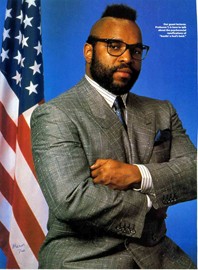
But my A-Team re-familiarization sparked a renewed interest in Mr. T’s varied career. And so I couldn’t resist delving into the Necklaced One’s musical oeuvre, which is basically (and merficully) confined to 1984’s Mr. T’s Commandments. Click here for audio of the man’s classic public-service ditty “Don’t Talk to Strangers”. It was apparently released as a 12-inch maxi, with a B-side of “The Toughest Man in the World”. If you have a copy, hit eBay and pay for your kids’ college tuition—it’s a real find.
Yesterday’s post about southeastern Bangladesh’s rodent invasion got me searching for recent example of rat-eradication campaigns. The hunt led me to Rat Island, Alaska, one of the remotest Aleutian Islands, where rats were introduced via shipwreck in the late 1700s. They’re since destroyed the vast majority of the island’s seabirds, and their pace of destruction has only increased since the fox population was removed in 1984.
So what to do? Round up a whole bunch of brodifacoum, some helicopters, and a bevy of “specialized bait-spreading buckets.” Then do your dirty work during the late fall or early spring, when the lady rats are pregnant. And watch out for the sea lions.
More on Rat Island’s anti-rat campaign here (PDF). We can win, and we will win.
Microkhan has previously opined on the redemptive power of Sri Lankan cricket. Today, alas, not so much. Fateful Boxing Day words from Javed Miandad, director general of the Pakistan Cricket Board, upon announcing the Sri Lankan tour:
Not only the cricket fraternity but the whole of Pakistan is thankful to the Sri Lankan president for clearing their tour to Pakistan. I hope more and more people come to watch Sri Lanka play in Pakistan because we want to prove to the world that Pakistan is safe and secure for cricket.
We should’ve known something might be up when the fans refused to show, despite Pakistan’s much-celebrated love of cricket. At one match in Karachi, for example, only 200 fans filled the 34,000-seat National Stadium, despite the fact that free tickets were being given away on street corners. Talk about the wisdom of crowds.


 Over the weekend, I finally got around to seeing Mel Gibson’s hyper-violent
  As Microkhan’s regular readers know well, Fridays ’round here mean it’s time for hilariously negative movie reviews of yore. This week’s victim is John Travolta’s Scientology-infused sci-fi stinker Battlefield Earth, which remains the great blemish on Forest Whitaker’s otherwise amazing career. How the man behind
 Looks like it’s curtains for the
  There’s little doubt that as Depression v2.0 inevitably worsens, civil unrest will become more commonplace. Even the august New York Times is letting aged stock pickers pop off about the need to
  Whenever there’s a budget crunch, space programs are usually the first to suffer. After all, their benefits (aside from bolstering national pride) are far from immediate, and rocket scientists usually make for poor lobbyists. So as Depression v2.0 kicks into ever higher gear, it seems certain that space exploration will suffer.
 Working on the screenplay yesterday, I spent way too many minutes groping for a way to describe a character’s gluttonous nature. I first described him as a fan of chicken gizzards, then of chicken skins, then of melted lard. I was close to wit’s end when the solution dawned on me: Pvt. Kelvin Brackett loves him some
  On April 16, the European Space Agency will launch the most powerful infrared telescope ever cobbled together by mankind: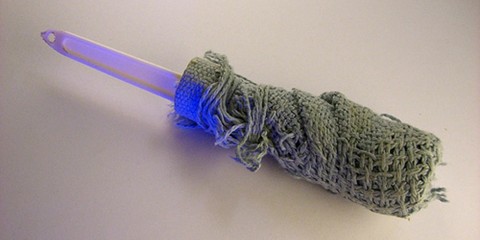
 It’s with great sadness that I must confess I’m old enough to remember, quite vividly, when right-wing militias were considered a serious threat to our nation’s survival. The notion seems quaint now, much like the dot-com bubble. But a mere 14 years ago, the leaders of the much-feared Militia of Montana were
 About a year ago, I started following the tragic case of an Alaskan charter flight that
  A
A  Another day, another gobsmacking tale of police impersonation, this time involving a 14-year-old Chicagoan who managed to
  Somewhat limited posting today, alas, as the Microkhan Squad is suffering from a topper of a cold. The Man long ago took the
  Thanks to the magic of Netflix’s “Watch Instantly” option, I recently became reacquainted with
  Yesterday’s post about