A tragedy in Stamford brings an old mystery to the fore: Why are chimpanzees so fantastically strong, at least compared to their human brethren? The rule of thumb states that chimps are five-to-seven times stronger, pound-for-pound, than members of our species (with whom chimps share 99 percent of their DNA).
That’s a bit puzzling, since chimps don’t appear anymore ripped than your average human (especially below the waist). The Air Force spent years investigating, by strapping both humans and chimps into “immobilization chairs” and testing each muscle individually. But these quasi-sadistic tests led nowhere.
In an explosive task, bonobo muscle performs superiorly to human muscle, most likely due to a higher specific force. Whether the difference is due to higher density of contractile material or due to differences in the contractile machinery per se (i.e. myosin heavy chain isoform) remains to be investigated.
While hunting about for photos of WWII-era Army prison camps, I stumbled upon the vintage snapshot at right, taken from the archives of the National Museum of Health and Medicine. It’s dated circa 1950, which surprised me a bit—I didn’t realize that prosthetic arms were that Robotech-y over a half-century ago. Turns out, however, that multi-jointed prosthetics date back to early 16th-century Germany; check out the Iron Hand of Götz von Berlichingen.
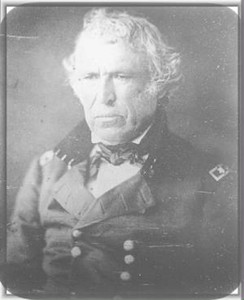
In honor of this blessed holiday, let’s give a shout-out to a president who rarely gets a lick of recognition (save for in the occasional Simpsons parody). Zachary Taylor was neither a disaster nor a titan of governance; he was, instead, sort of like presidential Muzak, a banal and utterly forgettable Whig whose most notable achievement was dying from gastroenteritis midway through his term.
If you’re heading out to any President’s Day cocktail parties, impress the crowd with these three Taylor tidbits:
*His nickname was “Old Rough and Ready,” in part because (and this is being charitable) he wasn’t exactly easy on the eyes. (A young Ernest Borgnine could have starred in a Taylor biopic.)
*Jefferson Davis was his son-in-law. However, Taylor himself was strongly opposed to secession, and once promised to hang any Southern rebels.
*Despite test results to the contrary, many conspiracy theorists still believe that Taylor was assassinated with arsenic, rather than felled by tainted milk and cherries.
Because it’s Friday, and because I’m fascinated by all things Mongolian: An illustrated guide to barbecuing marmots. It’s all about the rocks in the stomach, apparently.
And so Depression v2.0 has claimed another victim near-and-dear to Microkhan’s heart: Midway Games. Sumner Redstone left the company high-and-dry in December, selling his 87 percent stake for a measly $100,000—plus another $70 million in debt.
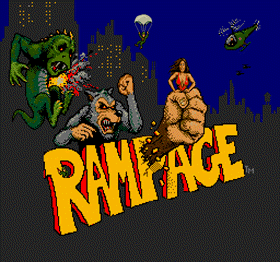
All the news stories have talked up Midway as the developer of the Mortal Kombat franchise. But the tear in my eye is due to nostalgia for Rampage, one of my all-time favorite arcade classics (right up there with Galaga and the vector-graphic Star Wars). I wasted many a junior-high afternoon at the local bowling alley, guiding Ralph the Giant Werewolf up the skyscrapers of Anywhere, U.S.A. Like yours truly as a pre-teen, Ralph was deeply misunderstood. We also shared a certain awkwardness around the ladies, which we dealt with in very different ways: Ralph grabbed screaming Fay Wray types out of windows, while I opted for a less confrontational approach.
If I had a spare $750 lying around, I’d be sorely tempted to buy this. But all petty cash is currently earmarked for groceries and health insurance. My inner eighth grader is deeply, deeply disappointed.
Wired “Senior Maverick” Kevin Kelly writes a touching ode to Amish hackers. The German-speaking denizens of Lancaster County may eschew modern conveniences, but they’re still plenty tech-mad. A key passage on a jerryrigged electrical system in an Amish woodworking shop:
The boss takes me around to the back where a huge dump-truck-sized diesel generator sits. It’s massive. In addition to a gas engine there is a very large tank, which I learn, stores compressed air. The diesel engine burns fuel to drive the compressor that fills the reservoir with pressure. From the tank a series of high-pressure pipes snake off toward every corner of the factory. A hard rubber flexible hose connects each tool to a pipe. The entire shop runs on compressed air. Every piece of machine is running on pneumatic power. Amos even shows me a pneumatic switch, which you can flick like a light switch, to turn on some paint-drying fans.
Our species’ adaptability never ceases to amaze me.
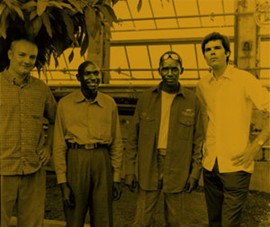
Back in the late ’90s, I got really into a band called Golden, featuring members of Trans Am as well as a young, pre-Mars Volta Jon Theodore. I last caught them at a Mercury Lounge show some ten years ago; I distinctly remember getting whapped in the face by a meathead’s twirling t-shirt. Since then, I’ve barely heard a blip.
Imagine my surprise, then, to learn that the band has since morphed into Extra Golden, and that half its membership now consists of Kenyan Benga stars. Americans Ian Eagleson and Alex Minoff remain; the former is an ethnomusicologist, which explains his Benga fascination.
Check out their new single here—a rock/Benga mashup that sticks to your brain like Krazy Glue. (Yes, that’s a compliment.) A full-length album, Thank You Very Quickly, comes out on Thrill Jockey in about a month.
On the heels of yesterday’s YBM Magnex post, let us now cast our fraud-seeking eyes southward toward Colombia, where 700,000 small investors have apparently lost everything in a blatant Ponzi scheme. The scam’s architect is David Murcia Guzman, who claims he’s a) misunderstood and b) a champion of the poor. Sounds like a regular Rod Blagojevich, if you ask me.
How do I know this guy’s a total huckster? Check out this description of his business model from the New York Times:
[Guzman] devised a business model of selling prepaid debit cards to customers who were also its salespeople. They could use the cards to buy items like electronics, or they could redeem points on different cards for cash in a few months’ time—provided they signed up new salespeople who would also buy the cards.
General rule of thumb: Never join a business that asks you to double as a recruiter.
As the husband of a lingerie designer, I’m accustomed to being surrounded by bra-and-panty images pretty much 24/7. My daily existence, in other words, could not possibly be more un-Iranian. Because as shown above, that nation’s censors make sure that no one gets a peek at non-family flesh.
This photo comes from the must-see Flickr gallery of David Mohammad Yaghoobi, a Brit now living on the outskirts of Tehran. Check out his great blog, too—essential reading for all who are curious about the real mood in Iran. Plus Yaghoobi has hooks in the renegade Tehran art scene, the mere existence of which gives me hope.
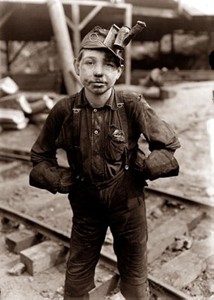
The main character in my (*knock on wood*) next book began life as a child coal miner, circa 1905. So I’ve recently taken a keen interest in accounts of what it was like to toil in the pits back then, especially for workers well shy of their tenth birthdays.
You will be completely unsurprised to learn that the work was significantly less-than-pleasant. A brief excerpt from John Spargo’s The Bitter Cry of Children, a classic piece of Upton Sinclair-style muckraking:
Crouched over the chutes, the boys sit hour after hour, picking out the pieces of slate and other refuse from the coal as it rushes past to the washers. From the cramped position they have to assume, most of them become more or less deformed and bent-backed like old men. When a boy has been working for some time and begins to get round-shouldered, his fellows say that “He’s got his boy to carry round wherever he goes.”
The coal is hard, and accidents to the hands, such as cut, broken, or crushed fingers, are common among the boys. Sometimes there is a worse accident: a terrified shriek is heard, and a boy is mangled and torn in the machinery, or disappears in the chute to be picked out later smothered and dead. Clouds of dust fill the breakers and are inhaled by the boys, laying the foundations for asthma and miners’ consumption.
And is there perhaps a rival study concluding that an unusual name makes you stronger? Were there are a lot of kids named “Genghis” back in early 13th-century Mongolia?
I moved away from my native Los Angeles at the tender age of 17, and I’ve never seriously considered moving back. Great town, don’t get me wrong, but I’ve always felt my future lay elsewhere—Dublin, Dee Cee, and now (for the past decade) Gotham.
That said, this site makes me crazy nostalgic for my hometown. Try as I might, I’ve yet to find up-to-snuff Mexican food back East. (And don’t get me started on Ireland.) There are definitely days when I’d sell my soul for some melt-in-your-mouth tacos. The truck that’s usually parked on 116th Street just west of Lexington is pretty solid, but I don’t wake up at 2 a.m. craving its greasy victuals.
I’ve only had the pleasure of visiting a small fraction of the joints featured on The Great Taco Hunt. But I can definitely vouch for Yuca’s.
From Foreign Policy, a list of insurgencies that refuse to die. They forgot a biggie, though: The New People’s Army, the military branch of the Communist Party of the Philippines. They’ve been waging their futile war since 1969, which makes the group older than the Tamil Tigers (1975) or Peru’s Shining Path (1980). This sad and sobering Time dispatch from 2007 examines how the rebels have managed to persist, despite their archaic ideology and lack of resources. This tidbit makes the NPA sound like a really twisted afterschool program:
About a fifth of N.P.A. fighters are under 18, according to Jane’s Information Group, an authority on defense and terrorism. Most of this 30-strong platoon are too young to recall the purges and, despite embracing communal life, have often joined the rebels for personal, rather than political, reasons. Many are high-school dropouts with no job prospects, impressionable youths whom the N.P.A. recruits and molds into loyal killers for the communist cause. For Joven, 21, joining meant personal salvation. “I had a different lifestyle before,” he says. “I was addicted to marijuana and alcohol. I hung out with a neighborhood gang.” Joven was shot during an offensive four months ago and the bullet rests painfully under his spine. But he says, “I’m happy with the comrades. Even though we come from different neighborhoods, from different classes, we fight as one.”
It comes as no surprise that the FBI is swamped with financial fraud cases nowadays. I knew this day of reckoning would someday come while watching The Real Housewives of Orange County on JetBlue a few years back. No financial system that could support such in-your-face opulence could possibly be on the up-and-up. (I remember being most horrified by a mortgage kingpin’s bored wife, who painted her horse’s toenails and drank more martinis per day than Jackie Gleason could handle at his lushiest.)
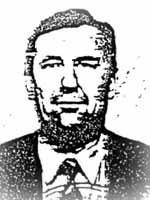
The fraud wave affords us an opportunity to glimpse back at other great scams of yore. Today’s pick: YBM Magnex, a maker of industrial magnets that turned into history’s biggest pump-and-dump scam. The company was headed by a man named Semion Mogilvech, last seen getting taken down by 50 Russian commandos. (Mogilvech may not have been kicking back enough pipeline wealth to the Kremlin.) There’s plenty more to be learned about the ultra-shady Mogilvech’s in the late, great Robert Friedman’s 1998 Village Voice opus, “The Most Dangerous Mobster in the World”.
The bloke pictured to the right of the post was a Mogilvech crony named Anatoli Tsoura, currently one of the FBI’s most wanted fugitives. If that’s the best picture they can come up, methinks they’ll have a hard time tracking the guy down. Seriously, dude looks like the leader of a 19th-century polygamist cult, not a contemporary gangster.
The dreaded Africanized honey bee has finally made its way to southern Utah, specifically the two counties that border Arizona. About time, considering that Utah agricultural authorities have been expecting to find such bees since 1999, when the “killers” first showed up in neighboring Nevada.
So it took the bees a full decade to cross the state line. Why are these ostensibly aggressive invaders so absurdly slow? Perhaps we should thank our friend, the fire ant, along with Old Man Winter and the humble mite.
Sorry to burst your killer-bee bubble, assuming you had one. If you prefer to think we’re all doomed, check out the 1974 B-movie classic Killer Bees, starring a pre-Charlie’s Angels Kate Jackson. They shot it in Francis Ford Coppola’s house, which makes me love the half-mad directorial genius all the more.
Violent yuckiness in the skies above Siberia. This sort of collision will become slightly more common as older satellites go “rogue” due to neglect. You can bet that companies such as Sirius and EchoStar are double-checking their disaster plans tonight.
This may be history’s only satellite-on-satellite mashup, but there have been other accidents in orbit. The first occurred on July 21, 1996, when the French CERISE satellite collided with debris from an Ariane 1 rocket that had launched a decade earlier. The debris was traveling 2,23231,694 miles per hour(!) at the moment of impact; amazingly, CERISE’s operators were eventually able to regain control of the satellite.
At some point, though, the debris is going to win. Good thing our species only inhabits a relatively small fraction of the Earth’s surface.
…celebs missing fingers. The Tony Iommi story is one of my favorites, since the sausage-factory accident helped contribute to his trademark sludgy sound. (To compensate for his altered anatomy, Iommi detuned his guitar three half-steps down.) Didn’t realize that Boris Yeltsin had been careless with a grenade, though.
This New York Times story is mostly about M.I.A.’s pro-Tamil sympathies, and how they’ve affected her rep back in her native Sri Lanka. (M.I.A.’s family was forced to flee to Britain due to her father’s political activities.) But the kicker touches on cricket, when a Colombo-based musician observes that ethnic differences tend to disappear on the pitch.
And how. In fact, the greatest Sri Lankan cricketeer of all time is a Tamil: Muttiah Muralitharan. The son a biscuit maker, Murali (as he’s best known) is a record-setting bowler, whose success is due in part due to a birth defect; he is unable to straighten his arm completely, which causes his throws to vibrate like mad.
More on Murali’s unusual anatomy (and the controversy it’s created) can be found here. And check him out demolishing Bangladesh (figuratively) here.
My son’s first birthday was on Sunday, so I just took him to the pediatrician for his one-year checkup. At the end of the appointment, I was handed a sheet detailing the main hazards that kids like Maceo face: Tylenol tablets, shade cords, plastic bags, etc.
Useful advice, for sure. But why didn’t the doc warn me about frickin’ alligators?
More alligator alarmism here (PDF). The paper’s conclusion includes the following bit of unassailable wisdom:
Actions to be avoided include allowing small children to approach bodies of water that may be inhabited by alligators.
Also, do not keep alligators as pets. If only Antoine Yates had listened.
Muzak Holdings, the company responsible for turning the reprehensible “Raindrops Keep Falling on My Head” into part of the cultural canon, has filed for Chapter 11. Too many of its retail clients have gone belly up in recent months, plus satellite radio was chipping away at its milquetoast market.
The news brought to mind this 2006 Australian study, the best analysis I’ve ever seen of music’s effect on consumer behavior. This bit of the conclusion goes a long way toward explaining why Muzak thrived for so long, despite the fact that everyone professes to hate it:
Slower tempo, lower volume and familiar music results in subjects staying marginally longer at a venue than when the tempo or volume are high, or the music less familiar
In other words, stodgy, slow, soft music warps time to some extent, and makes us linger over the racks of irregular Dockers a few minutes than we otherwise might.
Another Muzak must-read of yore: David Owen’s 2006 New Yorker piece, which doubles as a paean to commercial artistry (in the best sense of the phrase).
Since my Latgalian is tragically rusty, I can’t say for sure that the title of this post is, in fact, a vulgur term for anus. But according to the good folks over at YouSwear.com, u’kstapuc’e is precisely the word you should invoke upon being cut off by an aggressive driver in Daugavpils.
More Latgalian curses here. Eastern Latvia not in your travel plans? Prep for Mauritania here, or the Faroe Islands here. And might there be any Telugu speakers in the audience who can verify that lanja-kodka really means “son of a prostitute”?
No self-respecting country can do without an airline, and North Korea is no exception. The Hermit Kingdom’s lone commercial carrier is Air Koryo, founded in 1954 (as the less melliflously dubbed Choson Minhang CAAK). Alas, the airline’s destinations appear to be fairly limited; you can charter flights to Bangkok, Macao, or Sofia, but the normal service only goes to either Beijing or Vladivostok.
Further Air Koryo buzzkills: No radios, porn, or “written material in any language about the DPRK not published in DPRK.” And children under two years old must pay 10 percent of the adult fare.
Update: Per recent passenger reviews, Air Koryo may be better than I thought (assuming you don’t plunge into the Yellow Sea). “The food was satisfactory,” writes one happy customer, “with chicken, curry beef with rice, some melon-esque vegetable, bread, and dessert.” Take that, JetBlue snack basket!
With the 30th anniversary of Iran’s Islamic Revolution upon us, the late Ayatollah Ruhollah Khomeini is back in the news. How does a run-of-the-mill cleric become an ayatollah in the first place? Here’s the scoop, which I unearthed during my days as Slate‘s “Explainer” columnist. Two key tips: Study hard, and work on your rep.
Comments Off on Becoming an AyatollahTags:Iran·religion
Track-and-field records tumble with alarming frequency nowadays, but Yuriy Sedykh’s hammer-throw mark is a rare exception. The Ukrainian-born athlete set the world record back in 1986, while wearing the Soviet hammer-and-sickle on his uniform. Sedykh competed for another 17 years after that triumph, but he never again came within a meter of that legendary throw.
Nor has anyone else come within sniffing distance as of late. Last year’s top hammer throw was the handiwork of a Belarusian named Shako Dzmitry, who could only manage a relatively paltry 78.12 meters (versus Sedykh’s 86.74 meters). What gives? Athletes have only been getting bigger and stronger over the decades, and coaching presumably more expert. So why can’t anyone better Sedykh’s record—including the great man himself? [Read more →]
I was researching the arms trade the other day when I came across this amazing tale from Nigeria. It involves a fisherman-turned-arms-smuggler, who was ensnared not by the police, but rather by a celebrated vigilante named Alhaji Ali Kwara. Turns out that Mr. Kwara has been a rather busy man of late, personally arresting ten armed robbers, helping the Bauchi State cops eradicate crime, and (I kid you not) fending off about a dozen assassins. (Lesson to be learned from last incident: Do not attempt to rehabilitate armed robbers on your own.)
Though Mr. Kwara is certainly a courageous and fascinating man, one does have to wonder what his activities say about the state of law-and-order in northern Nigeria. As a general rule of thumb, you want law enforcement to be in the hands of government, not vigilantes—even ostensibly honorable vigilantes such as Mr. Kwara. My hunch is that much of the local security apparatus is on the take, which explains why the incorruptible Mr. Kwara is held in such high esteem. But allowing private citizens to assume the duties of the police often leads to sorrow.
The United States, of course, has its own ignoble history of rampant vigilantism. Troubling case in point: The Bald Knobbers.
A compendium of supreme artery cloggers. For the record, I’ve had the deep-fried Mars bar. Not sure I’ll ever be man enough for the Mega Pizza, which features pigs-in-blankets in lieu of crust. (h/t Joel)
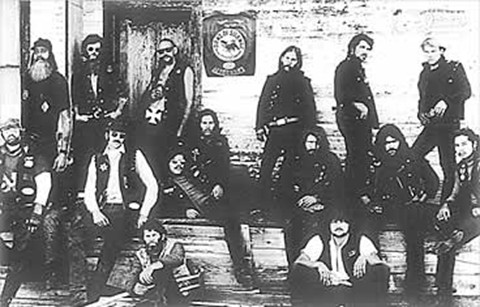
According to the Feds’ latest threat assessment, there are as many as 520 outlaw motorcycle gangs (OMGs) operating in the U.S. But only five are menacing enough to get called out by name in the report’s appendix—the usual suspects (e.g. Hell’s Angels, Bandidos), plus a more obscure group known as the Sons of Silence.
Uncle Sam says the club’s 250-275 American members are involved in “murder, assault, drug trafficking, intimidation, extortion, prostitution operations, money laundering, weapons trafficking, and motorcycle and motorcycle parts theft.” (What, no gambling?) The Sons of Silence, however, beg to differ. According to the club’s website, their only crime is copyright infringement (since it’s highly doubtful they received permission to use the Anheuser-Busch logo). Who to believe? And how did Coke, Conehead, and Skinny shed their mortal coils?
Oh, and here’s a primer on what OMGs mean when they invoke the term “1%”.
How do you know when you’ve finally stumbled across the jungle mansion of V. Prabhakaran, leader of the Tamil Tigers? Peek in his closet:
The suspicion that Prabhakaran was frequenting the place was further confirmed by the fact that the troops came across an expensive Marks & Spencer shirt of 42 1/2 cm size, which is also said to be the shirt size of the Tiger leader.
Additional photos of the rough estate here. And on a more serious note, here’s a moving plea for reconciliation between Sri Lanka’s Sinhalese majority and Tamil minority. Hooray for the redemptive power of cricket.


 While hunting about for photos of WWII-era Army prison camps, I
  In honor of this blessed holiday, let’s give a shout-out to a president who rarely gets a lick of recognition (save for in the occasional
  And so Depression v2.0 has claimed another victim near-and-dear to Microkhan’s heart:
  Wired “Senior Maverick” Kevin Kelly writes a
  Back in the late ’90s, I got really into a band called
 The main character in my (*knock on wood*) next book began life as a child coal miner, circa 1905. So I’ve recently taken a keen interest in accounts of what it was like to toil in the pits back then, especially for workers well shy of their tenth birthdays.
 It comes as no surprise that the FBI is
  The dreaded Africanized honey bee has finally
 This
This  No self-respecting country can do without an airline, and North Korea is no exception. The Hermit Kingdom’s lone commercial carrier is
  According to the Feds’ latest